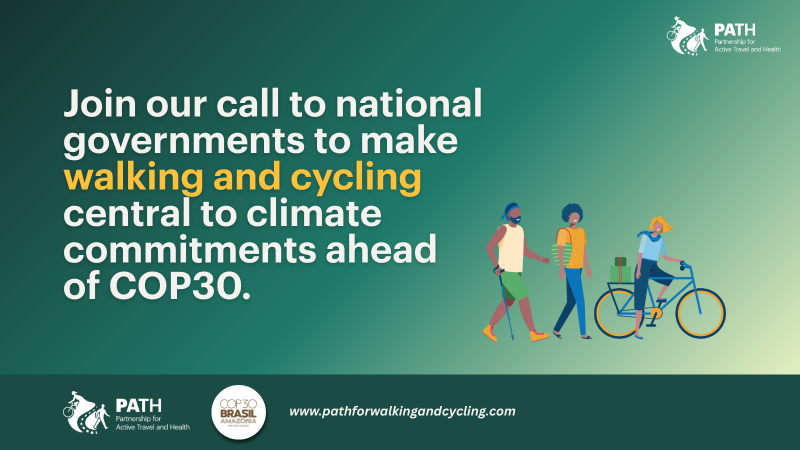
The Partnership for Active Travel and Health (PATH), and its 400 supporters including iRAP, have called on national governments to join the momentum for integrating walking and cycling into their Nationally Determined Contributions (NDCs) in advance of COP30 with the signing of an Open Letter.
Enabling more people to walk and cycle safely and to access public transport by foot and by bicycle can help cut transport emissions in half by 2030 and is a fast-track way to achieve progress on urgent climate goals and the Paris Agreement.
PATH research shows that two-thirds of countries now have active travel policies, but current commitments too often fall short of the ambition needed to ensure they address the climate imperative.
Policymakers are urged to follow PATH’s Active Travel Policy Template (2025) for a comprehensive step-by-step guide to creating an effective policy to promote walking and cycling as part of their country’s climate commitments. This will also enable the millions of people walking and cycling to avoid the potential emissions that would be generated from alternative choices and encourages existing polluters to shift their habits and benefit from the better conditions.
The framework recommends iRAP indicators as measures of successful actions for improving road infrastructure safety for pedestrians and cyclists. It also contains inspiring examples of 20 national actions that, when delivered, have a measurable impact.
New policies from countries like Brazil, Cambodia and Lesotho show what’s possible. Their planned actions, come with targets and funding, promising safer, cleaner and more enjoyable walking and cycling experiences.
Additional support materials include:
- The PATH Dashboard visualises data from PATH’s 2023 report National Policies for Walking and Cycling in all 197 UNFCCC countries. It offers an overview of the progress made by countries in integrating walking and cycling strategies into their policy frameworks and NDCs. It also facilitates direct comparisons between countries and pinpoints areas requiring additional investment and ambition.
- The PATH Walking and Cycling Regional Fact Sheets feature a comprehensive set of infographics analysing NDCs and walking and cycling policies across the six WHO- defined regions, detailing their objectives, actions, investments, and evaluations.
COP30, the UN Climate Change Conference, is being hosted in Brazil, and provides is a critical opportunity to embed sustainable mobility into global climate action.
PATH, and their supporters, urge all national governments to submit ambitious NDCs without further delay. Now is the time to scale up ambition, investments, and embed walking and cycling in climate strategies to reduce pollution, benefit public health and create vibrant, inclusive and equitable societies.

 English
  Português do Brasil
  Français
  Tiếng Việt
  Русский
  Español de Colombia
  Nederlands