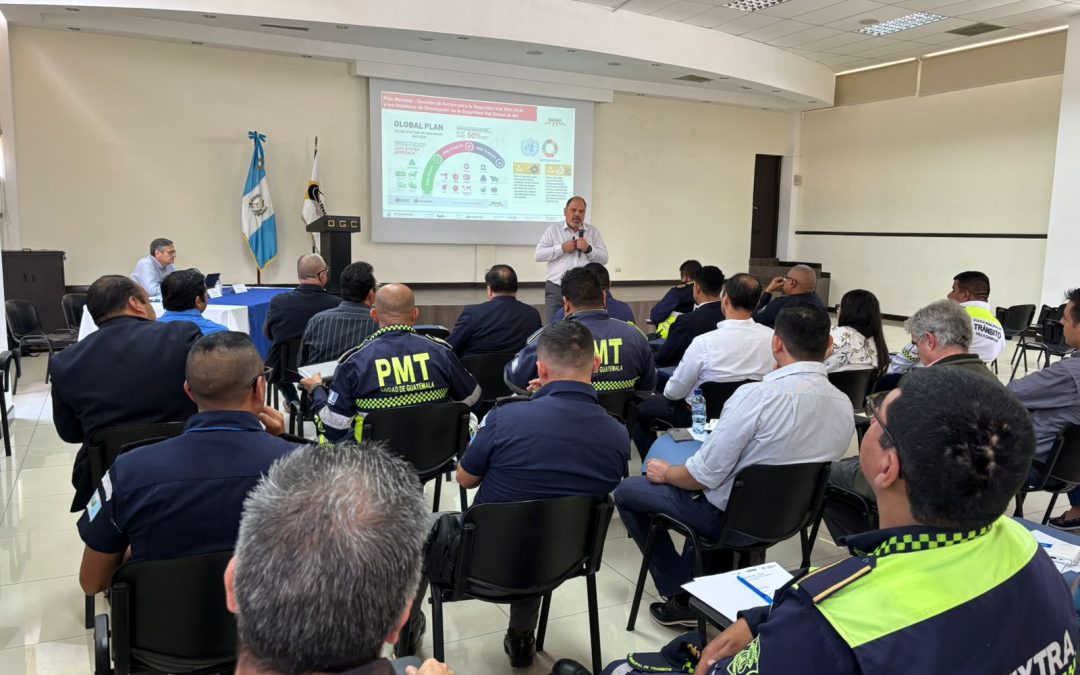
Edgar Zamora, iRAP Safer Journeys Lead for Latin America and the Caribbean, participated in a high-level road safety event in Guatemala this week, delivering key presentations that highlighted the critical role of data-driven infrastructure management in saving lives and preventing serious injuries due to road crashes.
The Road Safety Forum, attended by leaders of highway concessions, road authorities and industry, was co-organised by the Automobile Club of Guatemala, the Ministry of Communications, Infrastructure and Housing, 3M, and the Foundation for the Development of Guatemala (FUNDESA).
With funding from the FIA Foundation, a demonstration project will soon assess 200 km of the CA2 Occidente Highway, a critical economic corridor linking Guatemala with Mexico. The project aims to identify high-risk road sections and guide strategic investment to maximise safety for all road users.
Mr Zamora presented the value of iRAP’s globally recognised methodologies and tools in supporting Guatemala’s priority infrastructure development programme, now gaining momentum following the approval of a new national road safety law. His presentations underscored how evidence-based iRAP road safety assessments can inform strategic infrastructure investment to reduce road trauma and support implementation of the Global Plan for Decade of Action for Road Safety 2021-2030 and achievement of UN Targets 3 and 4 for safer road infrastructure.
From safe motorcyclist riding to strengthening road safety alliances, the Forum addressed key topics such as inter-institutional coordination in concessions, connection between infrastructure and regional development, road safety and technology investment funds, and human behaviour factors.
The event also celebrated the impressive progress of local engineers trained in iRAP’s Star Rating for Schools (SR4S) Programme. Some 40 engineers have assessed nearly 90 schools, resulting in the allocation of budget to improve safety at 35 schools by 2025.
Guatemala’s road safety journey has deep roots, building on the findings of 1,022km of iRAP road safety assessments in the country. Guatemala was part of a large Pacific Corridor road safety assessment across seven countries performed by the Inter-American Development Bank (IDB) in 2011. Based on the results and Safer Roads Investment Plan, IDB invested around US$1.76 billion to 2020 to eliminate high-risk road sections and save lives along the corridor. A repeat assessment conducted in 2020, from Guatemala to Panama, has obtained new Star Ratings to inform continued investment with the potential to save 65,000 lives.
“With strong political commitment, technical training, and data-led planning, Guatemala is well on its way to making safer journeys a reality,” said Edgar Zamora. “We are proud to support the country’s ambition to make every road journey safer for all.”
According to iRAP’s Safety Insights Explorer, achieving UN Target 4 for greater than 75% of travel on 3-star or better roads for all road users in Guatemala by 2030 stands to save in excess of an estimated 700,000 lives and serious injuries over the 20-year life of road treatments with an economic benefit of US$1 billion – $23 for every $1 spent.

For more information:
- On iRAP partner activity in Guatemala, visit the iRAP Partner Portal here
- On iRAP partner activity in Latin America and the Caribbean, click here.
Images source: iRAP

 English
  Português do Brasil
  Français
  Tiếng Việt
  Русский
  Español de Colombia
  Nederlands