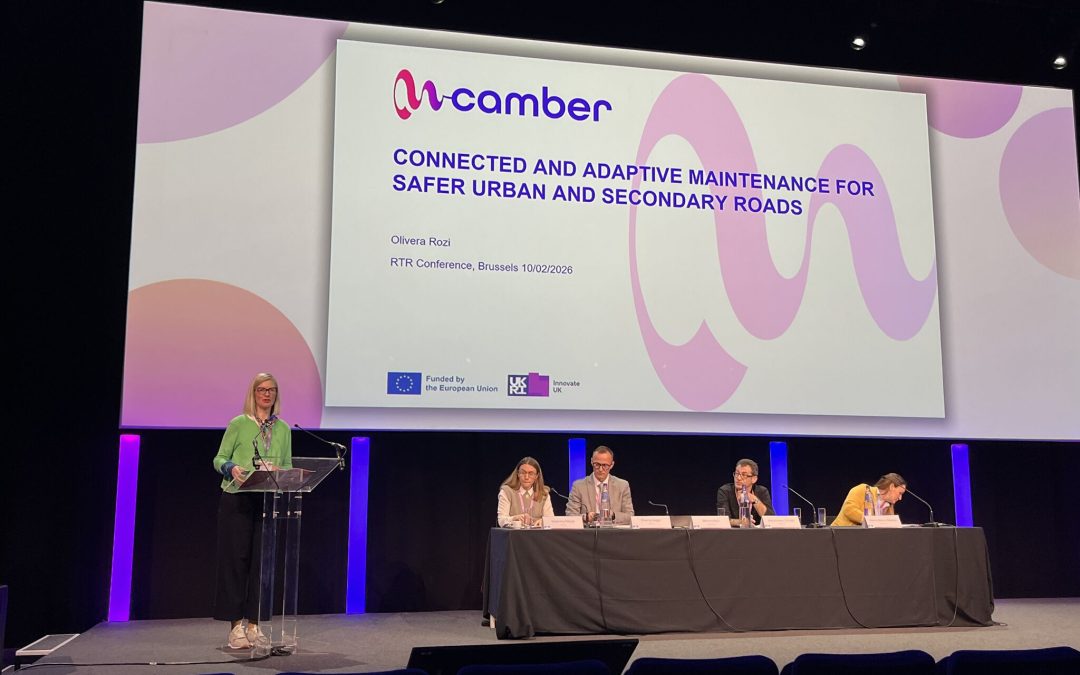
The CAMBER Project – for Connected and Adaptive Maintenance for Safer Urban and Secondary Roads – was proudly represented at this year’s RTR Conference in Brussels, which brought together leading European research and innovation initiatives in transport and mobility.
iRAP Safer Journeys Lead for Europe and the European Institute of Road Assessment (EIRA)‘s project coordinator, Olivera Rozi, presented CAMBER during Session 7 on 10 February. The session focused on better infrastructure safety on urban and rural roads, and CAMBER was presented alongside sister projects – EvoRoads and iDriving.
The session provided an excellent opportunity to exchange perspectives, showcase our approach, and connect with other initiatives working toward safer road infrastructure across Europe.
In addition, CAMBER was featured as part of the newly launched joint paper by the EU Road Safety Cluster on road safety data. This collaborative publication brings together challenges, solutions, and policy insights from eleven EU-funded projects and was initiated by the PHOEBE Project. The paper highlights the importance of data-driven approaches to improving road safety and strengthening policy development across Europe.
Several EU-funded projects also participated in dedicated RTR (Results from Road Transport Research) sessions, sharing research outcomes, lessons learned, and innovative approaches to improve road safety.
Recordings of the sessions are available on YouTube, including Session 7 featuring CAMBER, EvoRoads and iDriving.
🔗 Download the joint paper here
🔗 Watch Session 7 here
CAMBER remains committed to contributing to safer, more resilient road infrastructure through collaboration, innovation, and knowledge sharing across Europe!
About CAMBER
The Connected and Adaptive Maintenance for Safer Urban and Secondary Roads (CAMBER) project, co-funded by the European Commission and UKRI from 2025-2027, aims to develop and demonstrate workable solutions to integrate asset and safety management for urban and secondary road networks. At an estimated 725,000 km, Europe’s secondary roads account for over 90% of fatal and serious crashes, of which one in three involve a motorcyclist, bicyclist, pedestrian or other micromobility user. The project team is made up of 14 partners from across industry, academia and the non-profit sectors including ERTICO, EIRA, iRAP, SWOV Institute for Road Safety Research, Laboratorio Nacional de Engenharia Civil, iSENSE Group, BEMOBILE, FPZ, UHASSELT, Vicomtech, Agilysis, Austrian Institute of Technology (AIT), e-Trikala, Ministerio de Transportes y Movilidad Sostenible, and Red de Carreteras del Estado. Together, they are undertaking research and development into a range of new and innovative approaches using data, digital twins and vehicle-to-infrastructure technologies toward safety-centred maintenance and management of these roads. The approaches and tools will be tested in Spain, Croatia, The Netherlands, Greece and Portugal. The project comes at a pivotal time for European road safety targets, which aims to halve road deaths by 2030, and eliminate fatal crashes by 2050.
To stay updated on future CAMBER events and milestones, follow:
🔗LinkedIn: linkedin.com/company/camber-project/
🔗Newsletter: Sign up here

 English
  Português do Brasil
  Français
  Tiếng Việt
  Русский
  Español de Colombia
  Nederlands