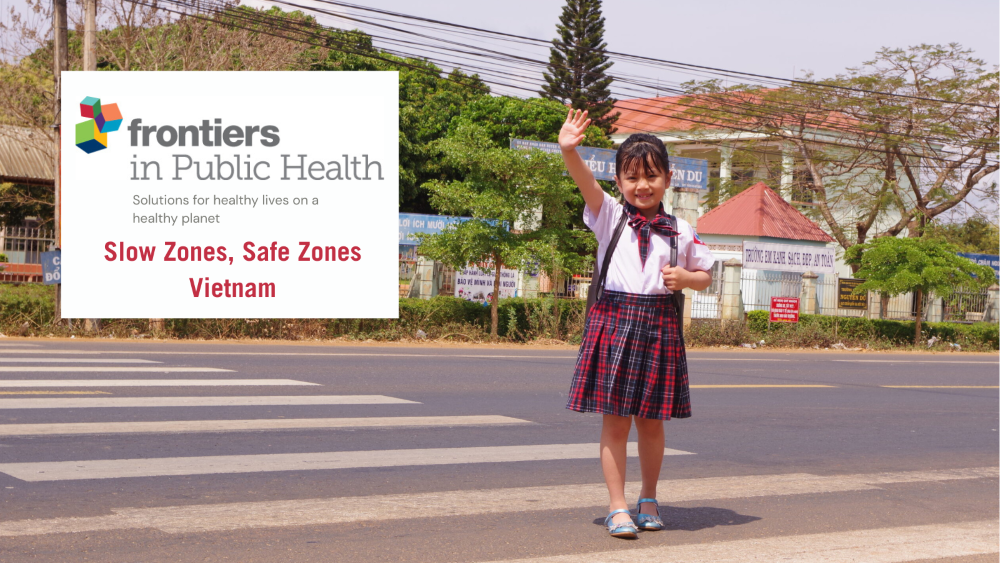
Frontiers in Public Health has published the results of AIP Foundation’s ‘Slow Zones, Safe Zones’ project in Vietnam which saw crashes plummet by 33% and school zone Star Ratings dramatically improved to 4- and 5-stars, impacting the safety of 17 million children.
The research entitled A Scalable Model for Child Road Safety in Low- and Middle-income Countries: Evidence and Lessons from the ‘Slow Zones, Safe Zones’ Intervention in Vietnam shares the results of the comprehensive, multi-year intervention in Pleiku City designed to reduce road crash injuries and fatalities by making school zones safer.
The multi-pronged strategy combined infrastructure upgrades, education and public awareness campaigns, speed limit reductions, enforcement, and policy development.
Key safety improvements included:
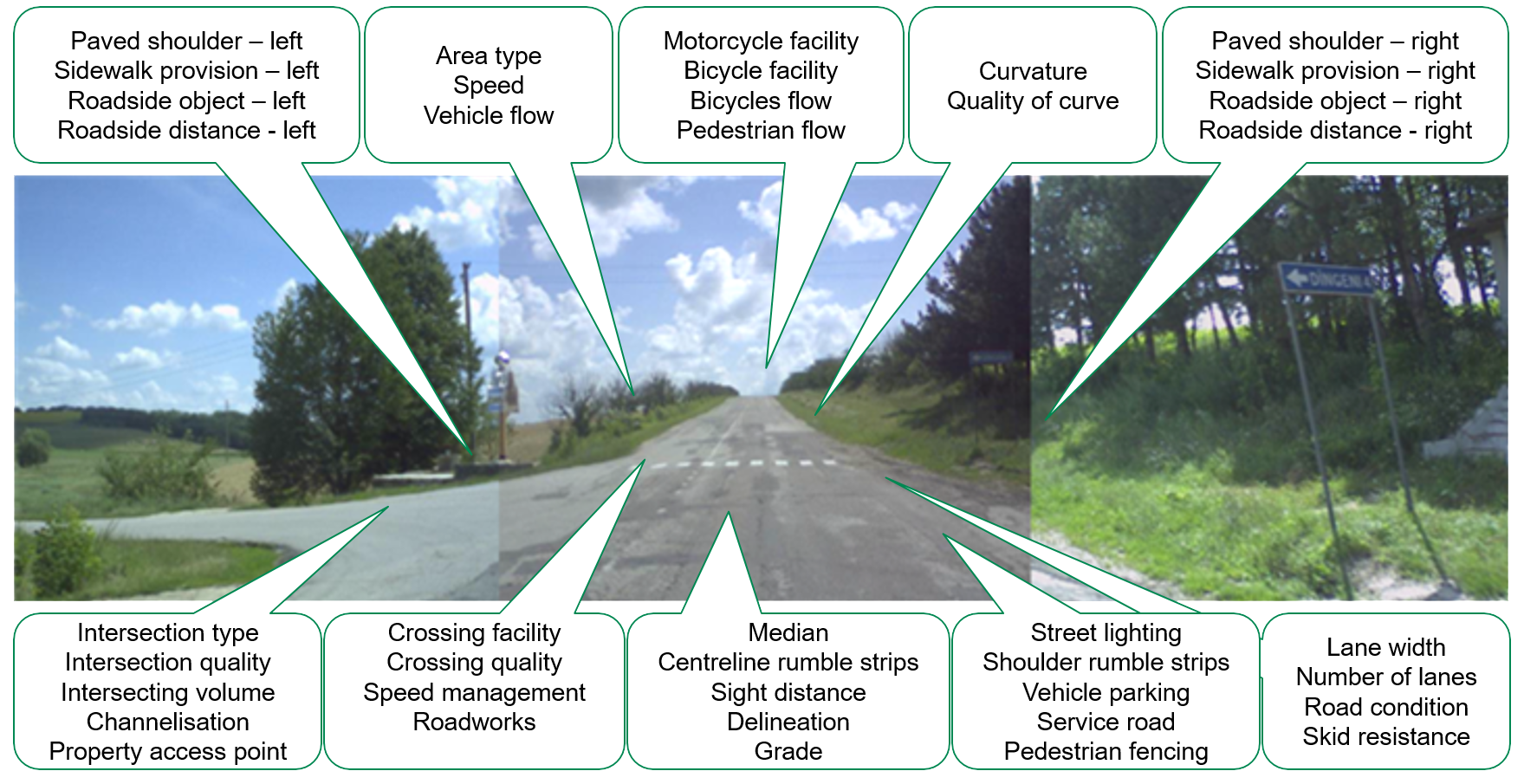
- iRAP Star Ratings for school zones dramatically improved from as low as 1-star to 4- and 5-star ratings post-intervention;
- Mean vehicle speeds were reduced by up to 28.9%;
- The proportion of student crashes occurring within school zones plummeted from 35.6% at baseline to 2.9% at the project’s end;
- Parental knowledge of correct speed limits increased substantially from 15.6% to 93.2% (p<0.001); and
- A legal decision by city authorities to formally adopt a “Safe School Zone definition”.
The initial project was part of the Botnar Child Road Safety Challenge supported by Fondation Botnar, the Global Road Safety Partnership, and the Fédération Internationale de l’Automobile. Subsequent phases were supported by the FIA Foundation and its Child Health Initiative.
It employed a phased design, beginning with a quasi-experimental pilot study (2018–2020) and expanding to a city-wide, pre-post evaluation (2020–2022).
The strong commitment of Pleiku’s local authorities, national stakeholders such as the National Traffic Safety Committee and the Ministry of Education and Training, together with funders Foundation Botnar and FIA Foundation, non-profits, and the private sectors, formed a powerful coalition for change.
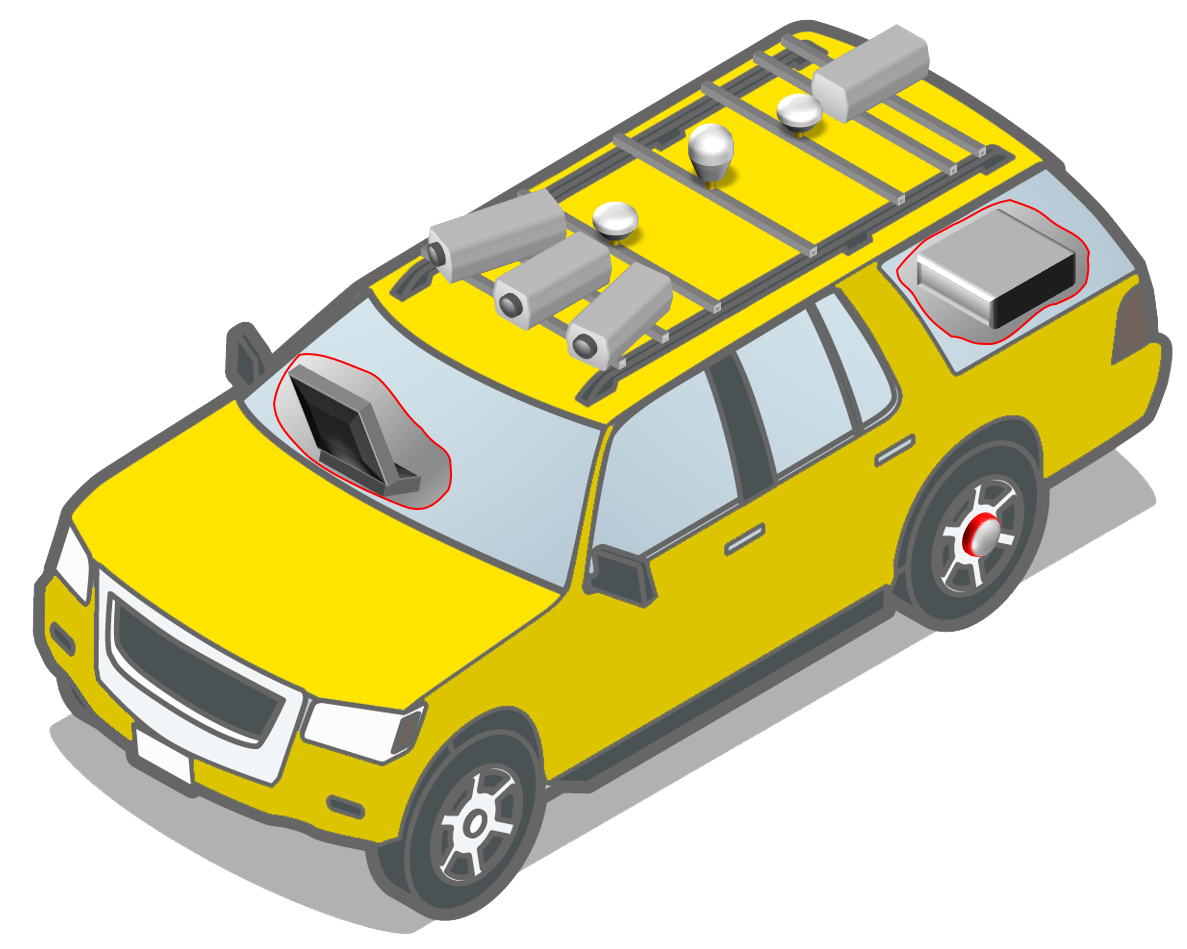
Project effectiveness was evaluated using evidence-based tools, including Star Rating for Schools (SR4S) assessments, vehicle speed surveys, and student crash and community surveys.
The project was highly effective, demonstrating that a comprehensive, evidence-based approach can significantly mitigate road risks for children in a low- and middle-income country context.
Its success in translating local data into official policy – a technical guide for local Vietnamese governments called the Safe School Zones Vietnam Guide – provides a powerful, scalable framework for national reform.
The model holds significant potential for replication in other low- and middle-income countries, offering a clear pathway to improve child road safety and help achieve the global targets of Sustainable Development Goal (SDG) 3.6.
The program was awarded a Prince Michael International Road Safety Award in 2020 in recognition of its success protecting children on their school journeys.
Image credit: AIP Foundation

 English
  Português do Brasil
  Français
  Tiếng Việt
  Русский
  Español de Colombia
  Nederlands