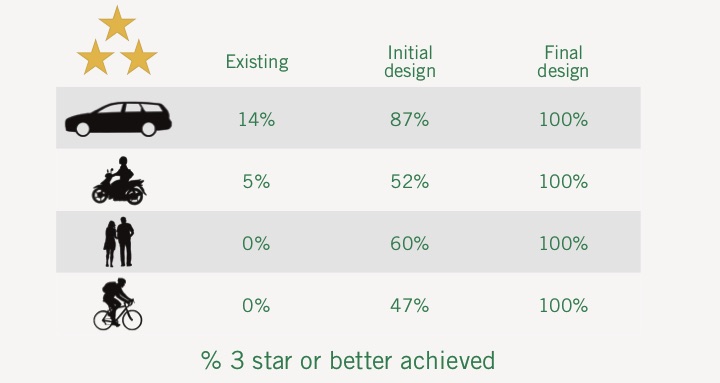
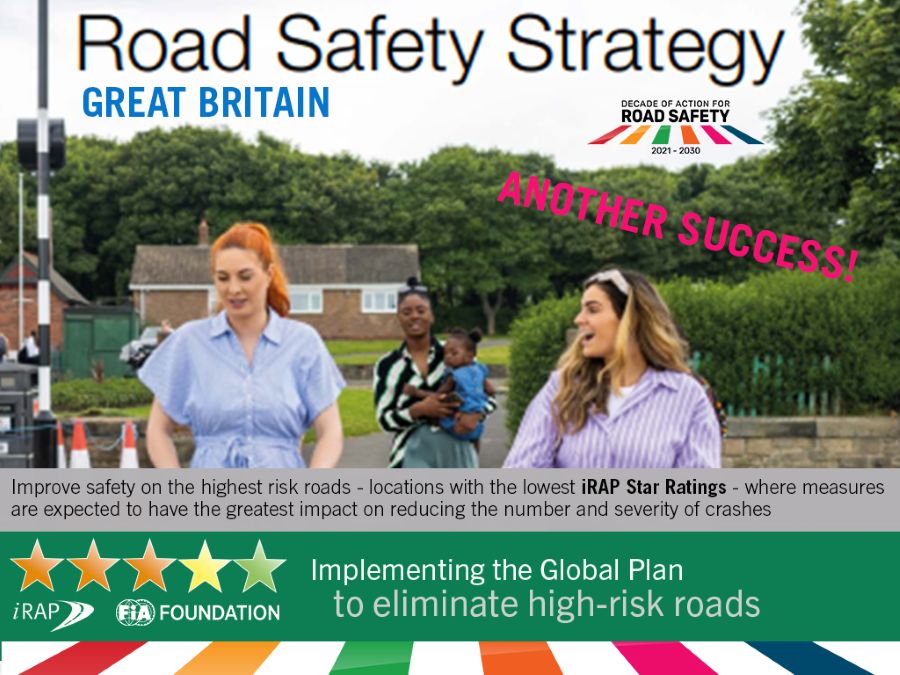
The UK Government has released its first road safety strategy in over a decade, with a plan to reduce fatalities and serious injuries on Britain’s roads by 65% by 2035, with an even more ambitious target of 70% for children under 16. It includes for strategic efforts to improve safety on the highest risk roads – locations with the lowest iRAP star ratings – where measures are expected to have the greatest impact on reducing the number and severity of crashes.
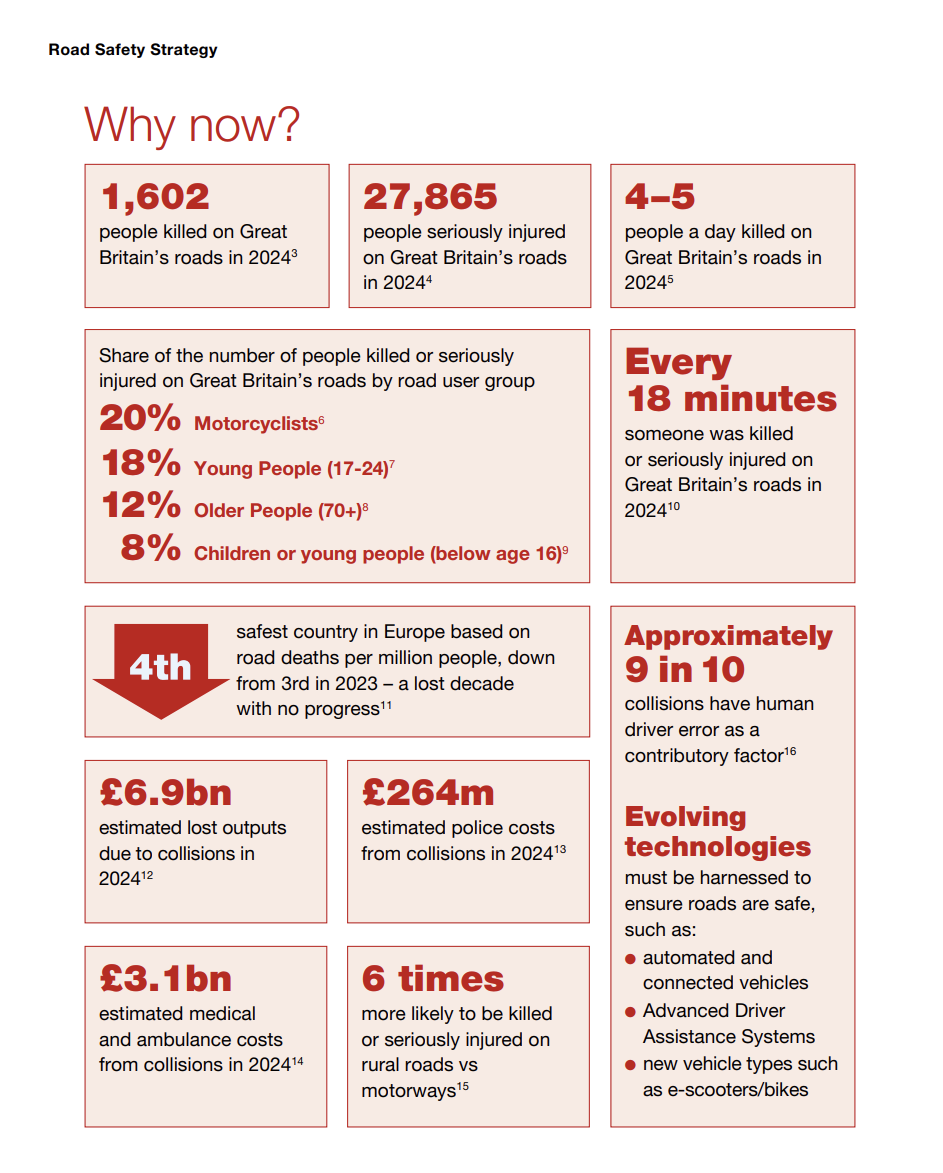
Approximately 4 people die on Britain’s roads every day, with thousands more seriously injured each year.
This strategy, sets out a new approach to reverse a decade of stalled progress by adopting the internationally recognised Safe System approach, which acknowledges that while human error is inevitable, deaths and serious injuries are not. Rather than placing responsibility solely on individual drivers, the system ensures that road design, vehicle safety, enforcement and education work together to protect all road users.
The Strategy is focussed on four themes:
- Theme 1: Supporting road users
- Theme 2: Taking advantage of technology, data and innovation for safer vehicles and post collision care
- Theme 3: Ensuring infrastructure is safe
- Theme 4: Robust enforcement to protect all road users
Safer roads, roadsides and speed
Safe roads and roadsides, and speed management will be important in improving road infrastructure safety for the most vulnerable road users. The following actions are planned:
- Continued support for National Highways to improve the safety of England’s Strategic Road Network
National Highways is working to deliver targeted road safety enhancements on the Strategic Road Network (SRN), comprising England’s motorways and major A-roads. From April 2026 – March 2031, National Highways will focus its efforts to improve safety on the highest risk roads where measures are expected to have the greatest potential impact on reducing the number and severity of collisions – i.e. those locations with the lowest iRAP star ratings. - Investing in a safer road network
The government will provide £24 billion of capital funding between 2026-27 and 2029-30 to maintain and improve motorways and local roads across the country. This future funding builds upon the record investment of £1.6 billion in local road maintenance for 2025 to 2026, representing a £500 million increase compared to last year. - Local roads and speed
Following research and consultation, the government will publish a new edition of the best practice guidance ‘Setting Local Speed Limits’ to support authorities to make the best decisions about managing speed. - Rural road segmentation
From early 2026, the government will explore whether the proposed rural roads categories are appropriate at a local level and assess their potential for national application. - Improving the safety of rural roads for motorcyclists
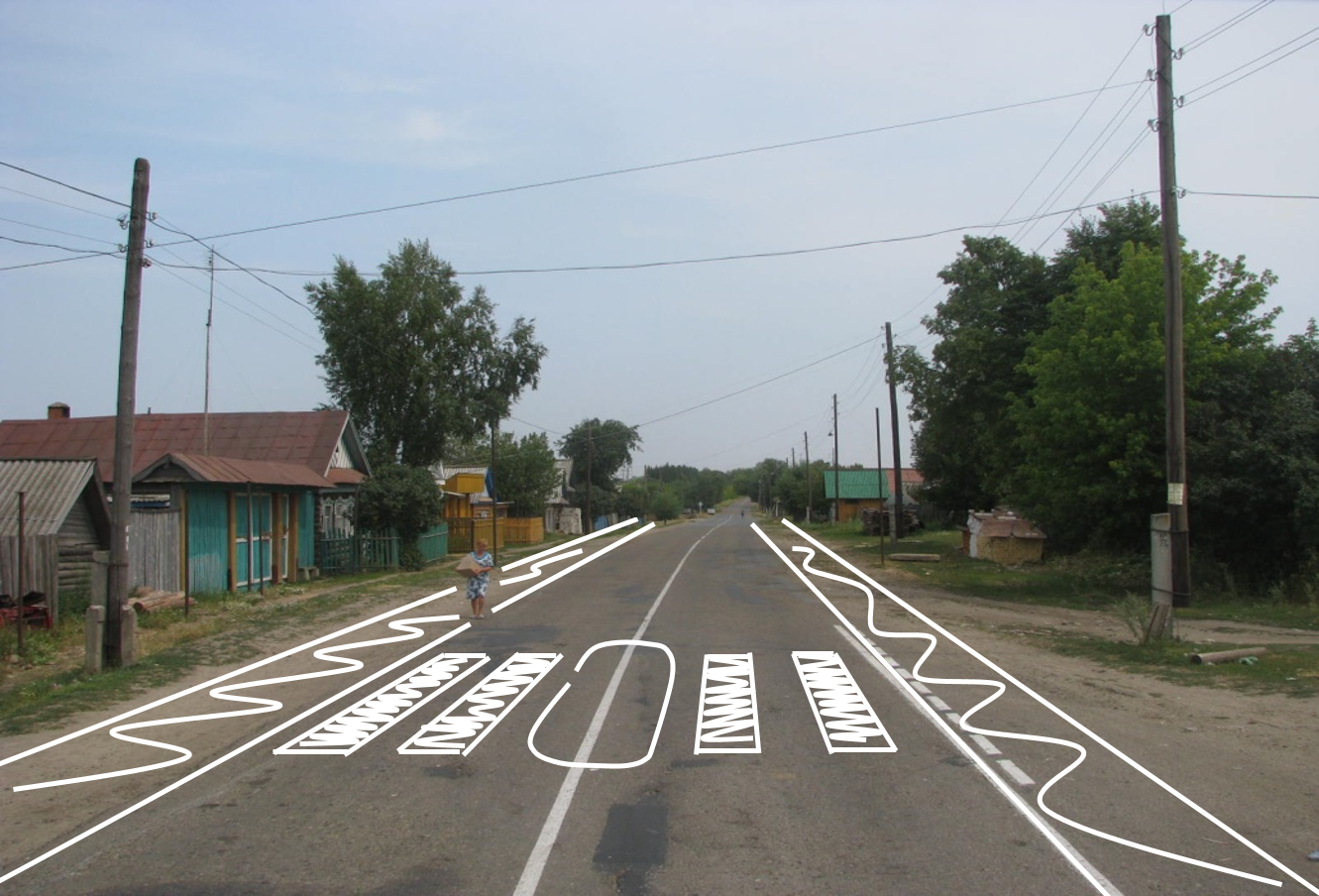
Project PRIME is a targeted road safety initiative designed to help motorcyclists navigate sharp bends more safely. It uses special road markings and signage to guide riders, encouraging better positioning and smoother braking. Following promising results, the government is supporting PRIME pilot trials in new regions. - Streetscape interventions that could reduce speeds
Safer streets support walking, wheeling and cycling, create safer school environments, and help shape places people want to live in. The Manual for Streets, published in 2007, marked a shift in street design by putting consideration of people walking and wheeling first, followed by cyclists – aligning with the Highway Code’s focus on protecting the most vulnerable. The government will publish an updated Manual for Streets and work to embed it within the planning policy and guidance framework, ensuring new roads promote low speeds and active travel. - Continuing to support smart motorways being as safe as possible
To ensure that the government is monitoring a comprehensive set of Safety Performance Indicators (SPIs), availability of data is being explored across a range of areas. An indicator under consideration is the flow weighted average iRAP Decimal Star Rating to monitor the safety of the most important roads.
Dr Suzy Charman, Director of the Road Safety Foundation (RSF) and United Kingdom RAP Lead expressed her congratulations to the Ministers and colleagues at DfT. “I know a tremendous amount of thought and effort has gone into this and we are delighted to have a road safety strategy and one that makes a strong statement on the direction of travel. The targets in the strategy are ambitious. If we reach the target of achieving a 65% KSI reduction by 2035 from a 2022-2024 base, some 95,500 fatalities and serious injuries will be avoided over the period. To us it is clear that strong commitment, great governance, significant investment and bold policy will be needed across the board to get there,” she said.
A new Road Safety Board, chaired by the Minister for Local Transport, will oversee delivery of the strategy, supported by an expert advisory panel drawing membership from local authorities, emergency services, active travel groups and road safety organisations.
We look forward to assisting the Department for Transport, National Highways and United Kingdom RAP partners to implement the Strategy supported by the iRAP methodology, tools, training and data.
Why now?
About United Kingdom RAP
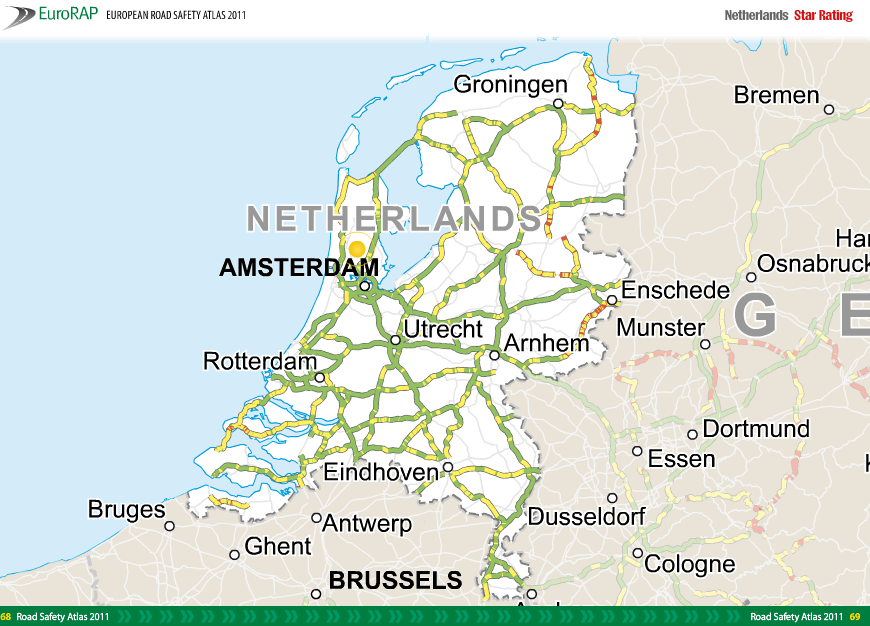
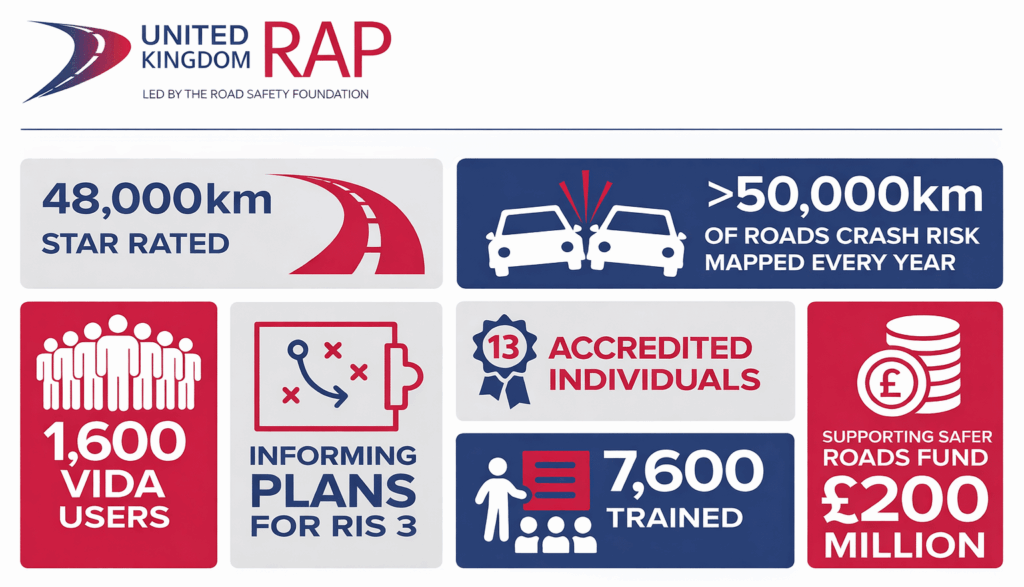
The UK was one of the four countries that founded the global RAP programme and United Kingdom RAP is a global exemplar. Each year, the RSF publishes crash risk mapping for more than 50,000km of motorways and A roads in Great Britain. 48,000km of roads and designs have been Star Rated. National Highways undertakes an iRAP Star Rating programme every five years and results published in 2022 showed the performance indicator for 90% of travel to be on 3-star or better roads by 2020 was surpassed, with 96% achieved. National Highways is using the iRAP approach throughout the organisation for strategic planning of investment, prioritisation of routes to be upgraded, and to ensure new road designs are as safe as they can be. Based on RSF’s crash risk mapping analysis, the Government is implementing a £200 million Safer Roads Fund to address safety on England’s 50 highest risk local A roads. The fund was awarded a Prince Michael International Road Safety Award in 2021.
roadsafetyfoundation.org/irap-in-the-uk/

 English
  Português do Brasil
  Français
  Tiếng Việt
  Русский
  Español de Colombia
  Nederlands