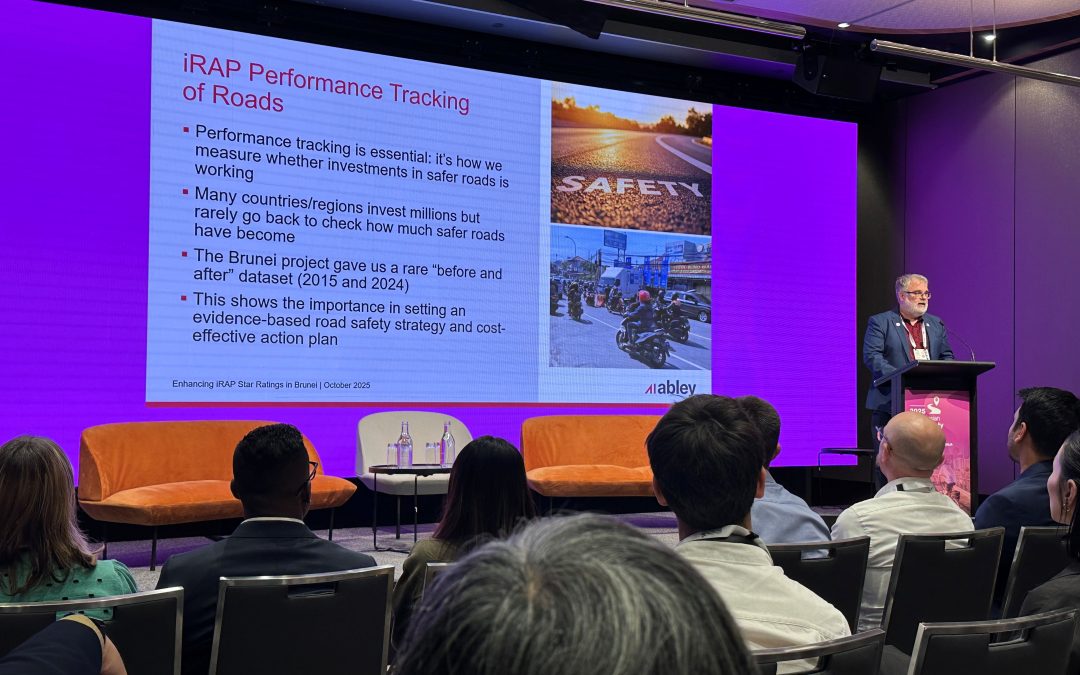
Dr Shane Turner, Technical Director of Road Safety, Abley shares Brunei’s results at ARSC2025
Brunei has tracked the safety performance of its strategic road network over ten years, achieving an impressive 65% lift in the percentage of roads rated 3-star or better, aligned to international standards.
Brunei’s Road Safety Strategic Plan 2020-2025 set out to adopt minimum 3-star iRAP requirements in the planning and design of new and improved existing roads, and to conduct iRAP assessments of existing roads.
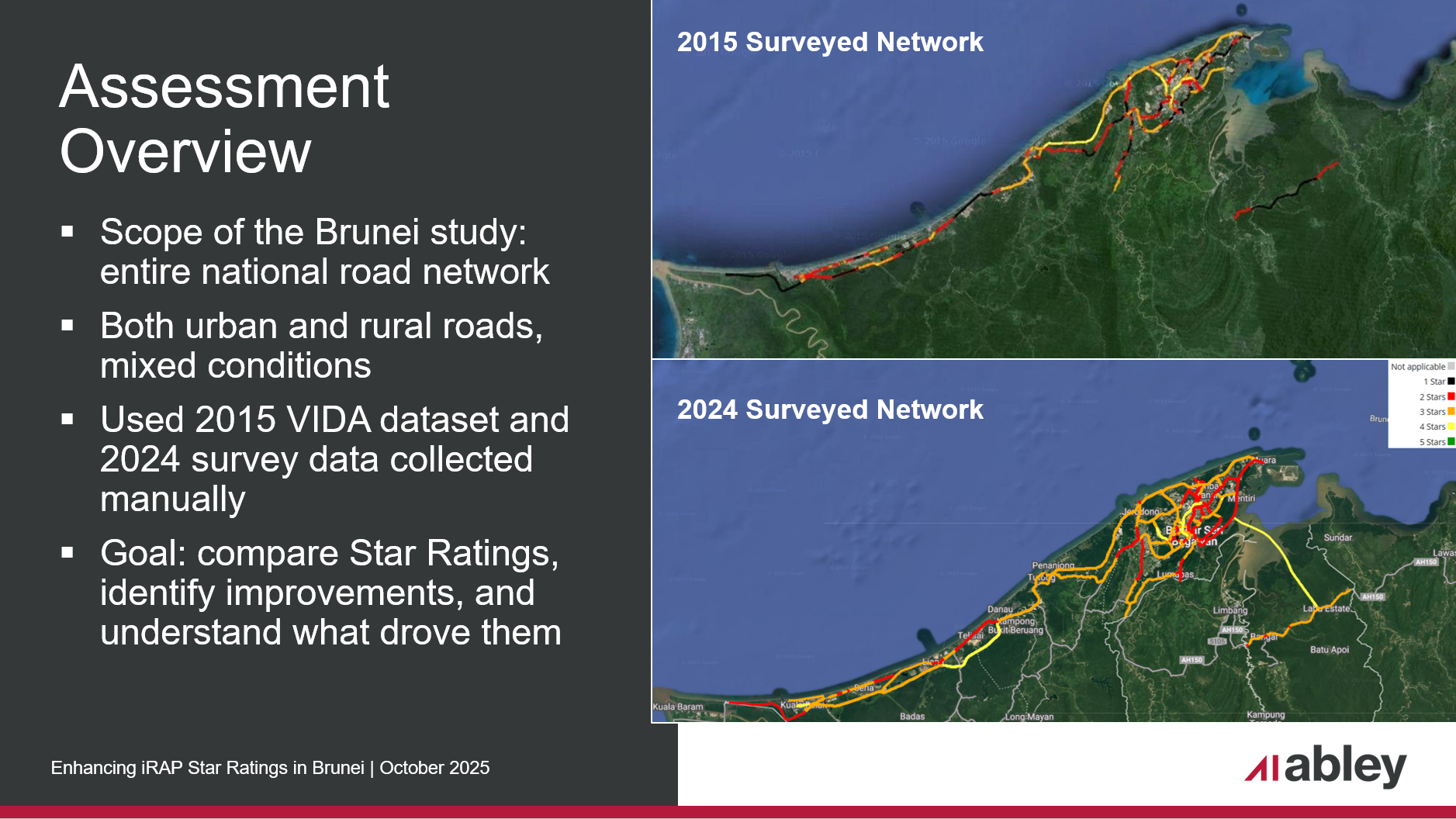
In a project funded by the Brunei National Road Safety Council (MKKJR), and managed by Jurusy Perunding Sdn. Bhd. working in conjunction with Abley, the Brunei Department of Roads Services (DOR) Public Works Department undertook comprehensive road safety assessments utilising the iRAP Star Rating Methodology in 2015 and again in 2024.
The results show a significant improvement in vehicle occupant safety, with the percentage of the network rated 3-star or better increasing from 46% in 2015 to 76% in 2024.
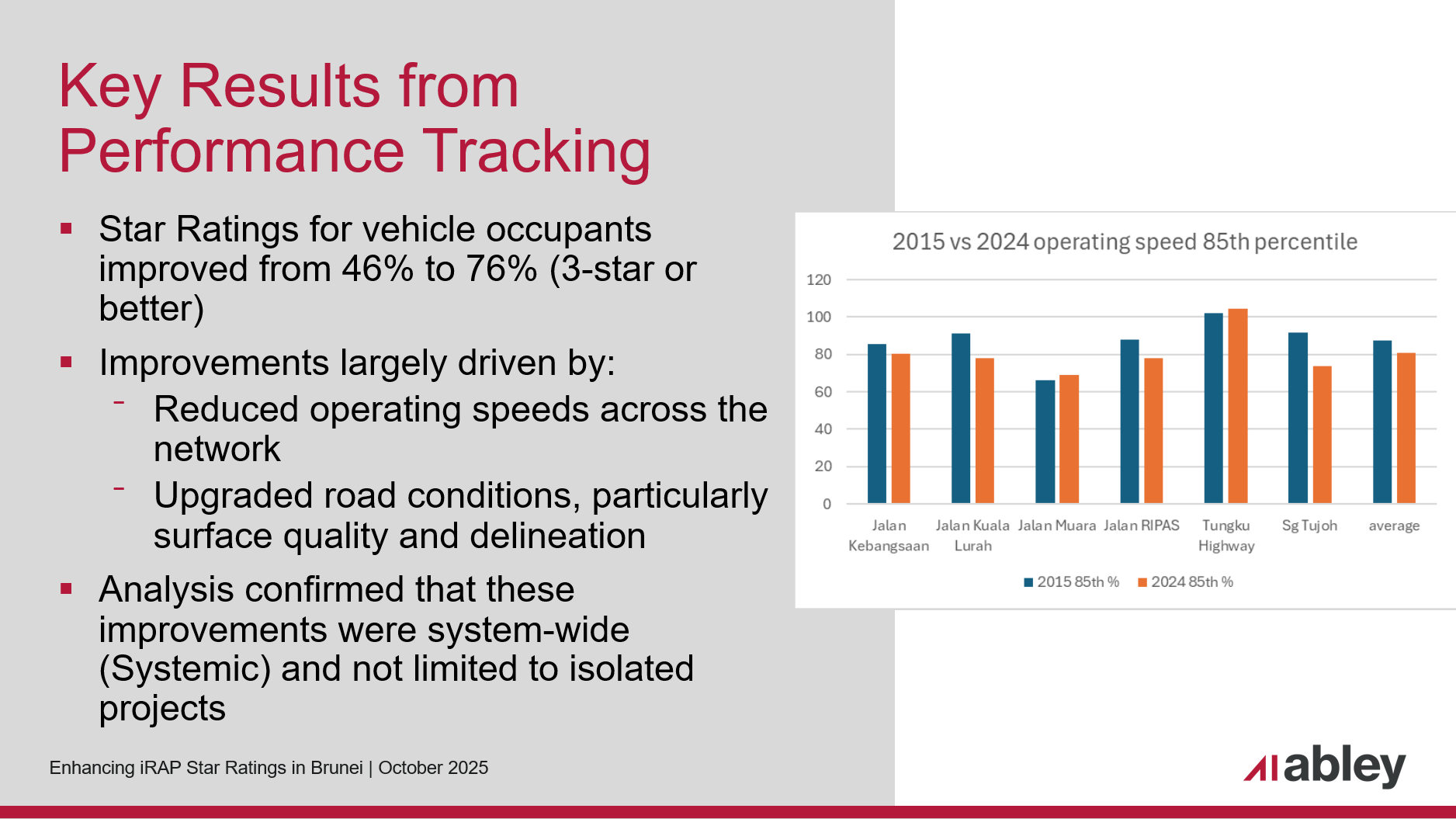
The positive change is attributed to reductions in operating speeds and improvements in road conditions, particularly in surface quality and delineation.
While vulnerable road user star ratings remain a concern, with most routes still rated 1 or 2-star for safety, the number of fatalities and serious injuries among these groups remains low, largely due to their limited presence on the road network.
The results were shared at the Australasian Road Safety Conference (ARSC2025) last month in Perth, and mark a critical step forward in the nation’s commitment to achieving the UN Global Road Safety Goals.
Speaking at the conference, Dr Shane Turner, Technical Director of Road Safety with Abley said, “Brunei’s progress demonstrates the power of evidence-based planning and investment in safer roads. Many countries invest millions of dollars in their roads but never go back to check how much safer they’ve become. Brunei has been an early and committed adopter of the evidence-based iRAP approach, aligning with global best practice. Performance tracking is enabling us to assess the effectiveness of our approach and if we are on-track to meeting Brunei’s road safety targets.”
The DOR is now prioritising implementation of Safer Roads Investment Plans (SRIPs) to upgrade the remaining 22% of the network still rated 2-stars, with a focus on high-impact, cost-effective safety improvements. Broader speed management and behaviour change efforts will also be critical to network-wide safety uplift.
AiRAP technologies will be explored for the management of future performance tracking.
“This is not just about meeting targets – it’s about saving lives,” Dr Turner said. “With AiRAP and prioritised investment informed by the SRIPs, we are preparing for the next generation of road safety innovation in the country.”

 English
  Português do Brasil
  Français
  Tiếng Việt
  Русский
  Español de Colombia
  Nederlands