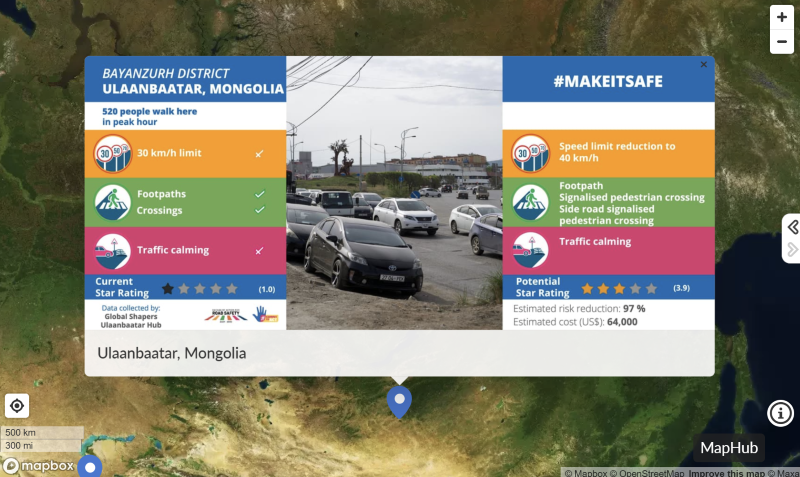
Nearly 200 Mobility Snapshots have been undertaken by NGOs in 79 countries informed by iRAP Star Ratings – helping to shine a light on dangerous intersections and simple solutions to transform road safety.
The Global Alliance of NGOs for Road Safety launched the Mobility Snapshot initiative in May 2024 to support NGOs in collecting simple, street-level data that capture the dangerous reality of people’s daily journeys and the proven solutions to make them safe.
NGOs across Africa, Asia, Australasia, Europe, and North and South America have used their Mobility Snapshots to expose how pedestrians and bicyclists are often overlooked in road design and to advocate for implementation of specific interventions at their chosen intersection.
Their efforts have led to tangible changes, such as the installation of pedestrian crossings and speed bumps at an intersection in Addis Ababa, Ethiopia; the implementation of a 20 km/h speed limit around a school in Sumqayit, Azerbaijan; widespread safety enhancements in Kampala, Uganda; and upgraded intersections in Neuquén, Argentina. These outcomes highlight the effectiveness of using data-driven advocacy to achieve safer streets.
Results thus far have shown:
2025
- 80 Mobility Snapshots in 35 countries at intersections
- More than 83,000 pedestrians and 8,000 bicyclists use these 80 intersections during peak hour
- Yet, key interventions to protect pedestrians and bicyclists are lacking in many:
- 46 lacked a speed limit of 30 km/h or lower
- 40 lacked traffic calming to reduce vehicle speeds around pedestrians and cyclists
- 60 lacked traffic calming to reduce vehicle speeds around pedestrians
- Only 7 intersections have bicycle paths
- 29 Snapshots were assessed by iRAP using the Star-Rating system
- Pedestrians’ risks of dying or being seriously injured could be reduced by 60% and up to 99% by implementing proven interventions
- Some intersections would cost as little as US$8,000 to implement recommendations
2024
- 118 Mobility Snapshots in 44 countries at intersections
- More than 156,000 pedestrians use these 118 intersections during peak hour
- Yet, key interventions to protect pedestrians and bicyclists are lacking in many:
- 102 lacked a speed limit of 30 km/h or lower
- 106 lacked usable pedestrian crossings on all legs of the intersection
- 67 lacked usable footpaths on all legs of the intersection
- 102 lacked traffic calming to reduce vehicle speeds around pedestrians
- 55 Snapshots were assessed by iRAP using the Star-Rating system
- Pedestrians’ risks of dying or being seriously injured could be reduced by 60% and up to 99% by implementing proven interventions
- Some intersections would cost as little as US$5,000 to implement recommendations

NGOs (Non-Governmental Organizations) play a vital role in supporting road safety globally and locally through their work to educate, advocate, implement and connect partners and opportunities. Their unique position between governments, communities, and the private sector, can allow them to drive change in ways that are often more agile, community-driven, and advocacy-focused.
iRAP is a member of the Global Alliance of NGOS for Road Safety.

 English
  Português do Brasil
  Français
  Tiếng Việt
  Русский
  Español de Colombia
  Nederlands