
Ressources RAP pour le RISM
Soutenir la mise en œuvre du RISM
Le gratuit Méthodologie RAP outils Les ressources sont fondées sur des données probantes et conçues pour être intégrées aux opérations routières et à la planification des investissements des agences, et soutiennent la mise en œuvre de l'accord européen Directive relative à la gestion de la sécurité des infrastructures routières (RISM).
Comment les outils RAP peuvent être intégrés dans votre agence
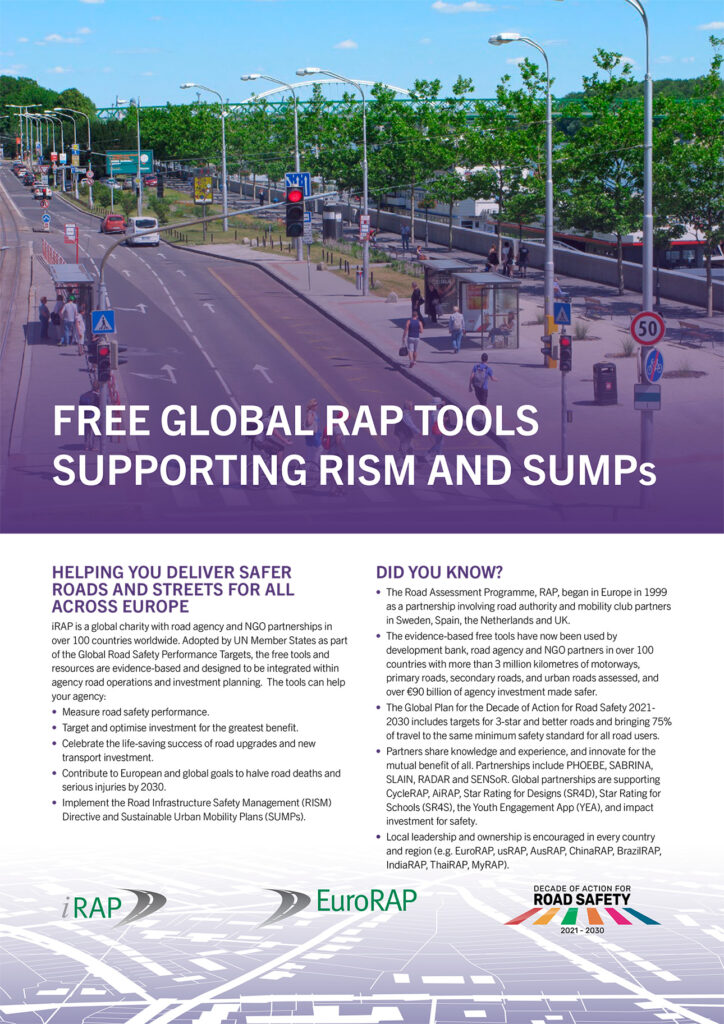
Téléchargez le dépliant des outils RAP mondiaux prenant en charge RISM et SUMPS Guide pratique pour l'évaluation routière à l'échelle du réseauComment le réseau RTE-T peut être élevé à un niveau de sécurité supérieurRapport spécial 04/2024 : Atteindre les objectifs de l’UE en matière de sécurité routière – Il est temps de passer à la vitesse supérieure (Cour des comptes européenne)
Saviez-vous?
- Le programme d’évaluation routière (RAP) a débuté en Europe en 1999 sous la forme d’un partenariat impliquant les autorités routières et les clubs de mobilité en Suède, en Espagne, aux Pays-Bas et au Royaume-Uni.
- Ces outils gratuits, fondés sur des données probantes, ont désormais été utilisés par des partenaires des banques de développement, des agences routières et des ONG dans plus de 100 pays, avec plus de 3 millions de kilomètres d'autoroutes, de routes principales, de routes secondaires et de routes urbaines évalués, et plus de 90 milliards d'euros d'investissements d'agences rendus plus sûrs.
- Le Plan mondial pour la Décennie d’action pour la sécurité routière 2021-2030 comprend des objectifs pour des routes 3 étoiles et mieux et pour amener 75% de déplacements au même niveau de sécurité minimum pour tous les usagers de la route.
- Les partenaires partagent leurs connaissances et leur expérience, et innovent pour le bénéfice mutuel de tous. Les partenariats comprennent PHOEBE, SABRINA, TUÉ, RADAR et Capteur. Les partenariats mondiaux soutiennent CycleRAP, AiRAP, Star Rating for Designs (SR4D), Star Rating for Schools (SR4S), le Application d'engagement des jeunes (YEA), Outil d'analyse des itinéraires et investissement à impact pour la sécurité.
- Le leadership et l'appropriation locaux sont encouragés dans chaque pays et région (par exemple EuroRAP, usRAP, AusRAP, ChinaRAP, BrazilRAP, IndiaRAP, ThaiRAP, MyRAP).
- Le projet « Sauver des vies : évaluer et améliorer la sécurité du réseau routier RTE-T » (TUÉ) y compris des pays tels que Italie, Croatie, Grèce et Espagne fournit des exemples concrets de la manière dont ces techniques ont été appliquées pour comprendre et mesurer les risques individuels et collectifs au sein des réseaux.
Études de cas
Voici des études de cas illustrant comment les outils et ressources RAP ont été et peuvent être utilisés pour soutenir l'exploitation routière et la planification des investissements des agences en Europe.
- Cartographie des risques pour orienter la sélection des étoiles.
- Études avant et après la mise à niveau du réseau.
- Identification des tronçons de route où installer un système 2+1 avec barrière centrale
- remèdes d'entretien uniquement.
- Évaluation du réseau routier et attribution d'étoiles à partir des plans de conception.