
Las políticas económicas para evaluar la inversión en viajes están desactualizadas, priorizan los viajes rápidos y convenientes en automóvil y no reflejan los valores modernos de seguridad y sostenibilidad. Es hora de reorientarse para ofrecer una movilidad segura, sostenible e inclusiva para todo Los usuarios de la vía, según un informe publicado hoy por la Fundación para la Seguridad Vial.
Invertir en una movilidad más segura: Dirigir la inversión a toda la red de carreteras británica. Se afirma que, en comparación con los datos previos a la COVID-19, las muertes y lesiones graves han disminuido, pero se prevé un retorno a los niveles prepandémicos de mortalidad y lesiones graves. Sin embargo, el reciente aumento del costo de vida podría afectar los niveles de tráfico, la velocidad de los desplazamientos y, por consiguiente, el número de víctimas. Además, es posible que se observe un efecto adicional debido al aumento del teletrabajo, una práctica ya consolidada para muchos tras la pandemia.
“Ahora es el momento de invertir en nuestra infraestructura vial para fomentar una movilidad más segura y sostenible para todos los usuarios de la vía”, afirma la Dra. Suzy Charman, Directora Ejecutiva de la Fundación para la Seguridad Vial y una de las autoras del informe. “Esto reducirá la presión sobre nuestros servicios de salud y, al mismo tiempo, contribuirá a la protección del medio ambiente, la salud y el ahorro en costes”.”
Las medidas de infraestructura vial que reducen el riesgo de lesiones graves y mortales son bien conocidas y la rentabilidad de la inversión es considerable. Medidas como la protección o la limpieza de los arcenes, la separación de vehículos que circulan en sentidos opuestos y el diseño de intersecciones más seguras ofrecen grandes oportunidades para salvar vidas. Fomentar la seguridad de los peatones y ciclistas mediante la habilitación de carriles separados o la reducción de la velocidad de los vehículos es fundamental para promover el cambio modal y disminuir las muertes y lesiones de estos importantes grupos de usuarios.
El informe anual de la organización benéfica sobre el riesgo de accidentes afirma que los argumentos a favor de la inversión en la reducción sistemática y planificada de los accidentes siguen siendo tan sólidos como siempre.
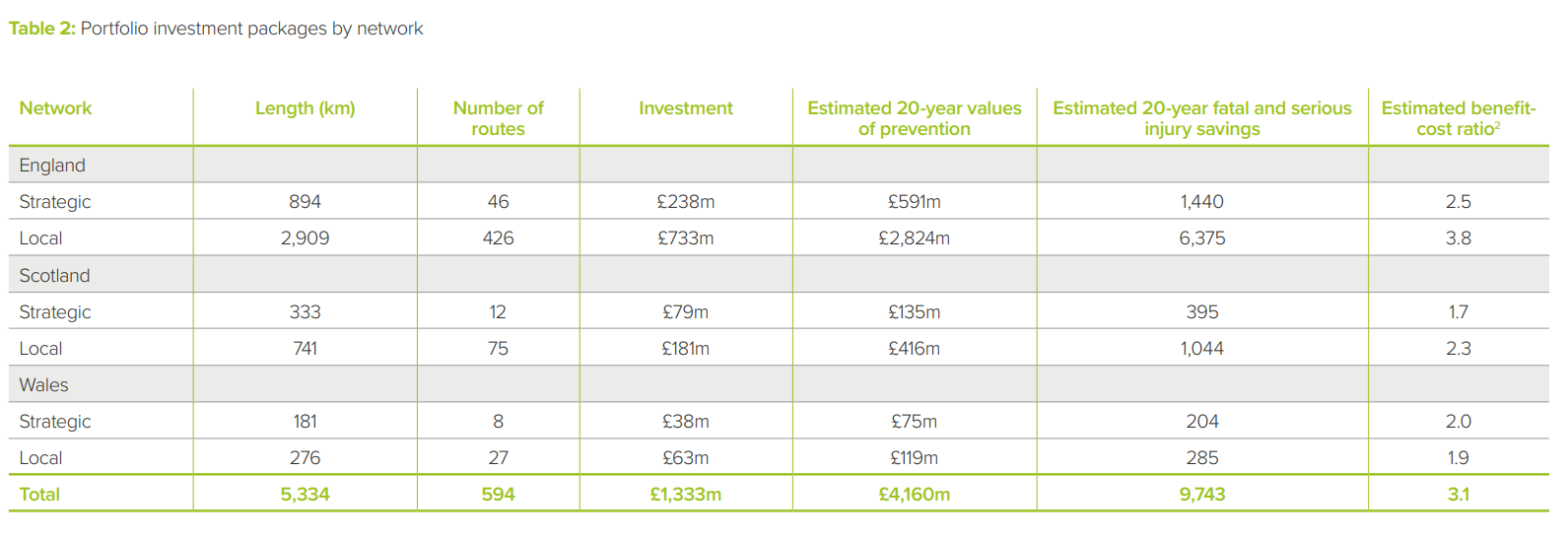
El informe destaca que el diez por ciento de las autopistas y carreteras principales son claramente prioritarias para la inversión. Los argumentos a favor de la inversión son sólidos, con opciones de inversión favorables en toda Gran Bretaña que no solo salvarían vidas, sino que también abordarían parte de las enormes pérdidas sociales atribuibles a los accidentes de tráfico cada año (alrededor de 30 mil millones de libras esterlinas en 2021).
Las rutas más mejoradas de Gran Bretaña
Se identificaron 52 rutas que mejoraron significativamente entre el primer período de datos (2015 a 2017) y el siguiente (2018 a 2020), con una longitud total de más de 1200 kilómetros. Entre ambos períodos de tres años, el número de accidentes mortales y graves ajustados en estas rutas disminuyó en 61%, pasando de 1058 a 404. El valor social anual de los accidentes evitados superó los 110 millones de libras esterlinas, o más de 90 000 libras esterlinas por kilómetro de carretera, con un valor social total superior a 1600 millones de libras esterlinas en 20 años. Algunos ejemplos de rutas que mejoraron significativamente son:
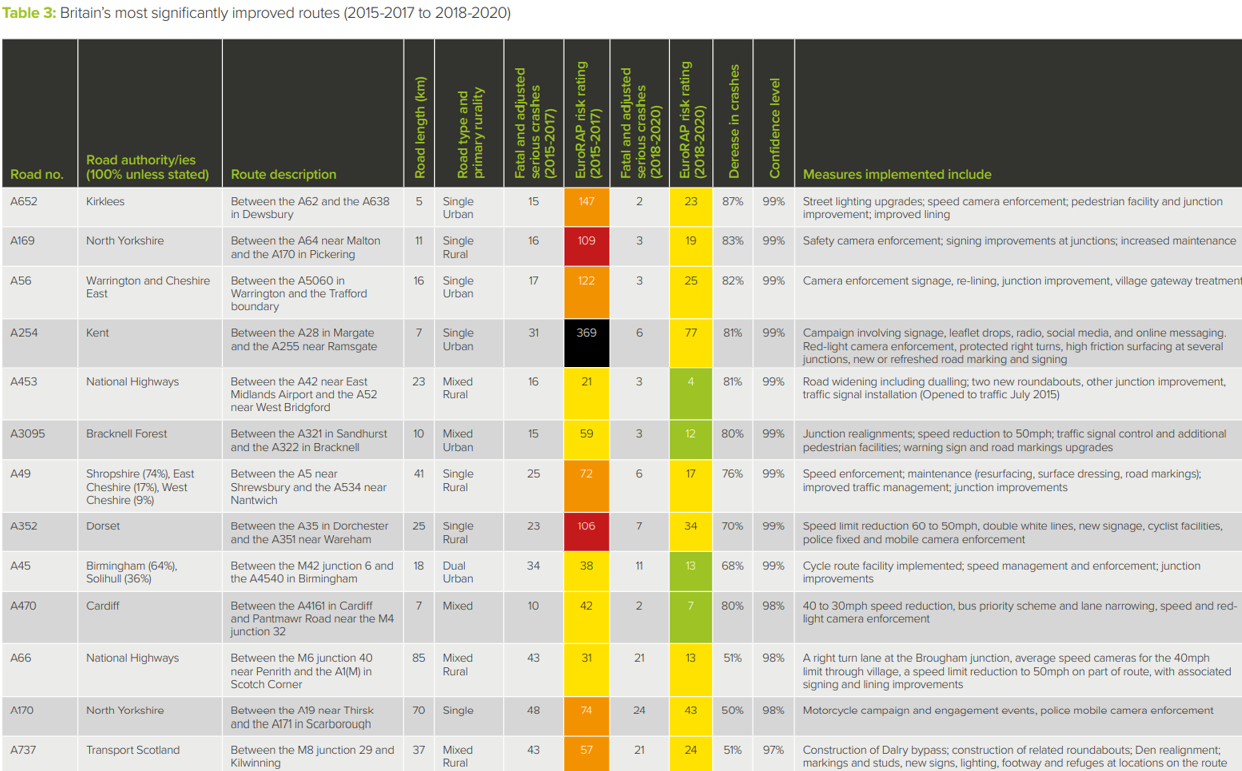
Si bien algunas mejoras consistieron en la ampliación de carreteras o la construcción de una circunvalación, la mayoría son modestas: alumbrado público, mejor diseño de intersecciones para peatones, señalización vial renovada, mejor control mediante cámaras y reducciones localizadas y específicas de los límites de velocidad.
La Fundación para la Seguridad Vial también proporciona una herramienta interactiva donde los usuarios pueden consultar la calificación de seguridad de las carreteras principales y autopistas de su zona.
Acerca de la Fundación para la Seguridad Vial (RSF)
La Fundación para la Seguridad Vial (RSF) es una organización benéfica del Reino Unido, fundada en 1986, que tiene como objetivo ayudar a reducir los accidentes de tráfico mediante la implementación de un sistema de transporte vial seguro a través de:
- Identificar paquetes de inversión con probabilidades de generar altos rendimientos y analizar el desempeño en materia de seguridad de las carreteras a lo largo del tiempo.
- Proporcionar el enfoque, las herramientas y la formación necesarios para ayudar a las autoridades viales a adoptar un enfoque proactivo para la reducción de riesgos en las carreteras.
- Realizar investigaciones para avanzar en el conocimiento y las políticas.
- Durante los últimos 20 años, la organización benéfica se ha centrado especialmente en mejorar la seguridad vial mediante la creación del Programa Europeo de Evaluación de Carreteras y el desarrollo del International Road Assessment Programme (iRAP) y sus protocolos para medir la seguridad de la infraestructura. La RSF lidera el Programa de Evaluación de Carreteras del Reino Unido. Su labor sirve de modelo de lo que se puede lograr, y sus investigaciones e innovaciones clave se están replicando en programas similares en todo el mundo.
Recientemente, la organización benéfica ha:
- Apoyó la inversión del Fondo para Carreteras Más Seguras del Departamento de Transporte (DfT) de 2018, realizando estudios de las 50 carreteras locales de categoría 'A' con mayor riesgo en Inglaterra, capacitando a las autoridades locales y modelando el impacto de los programas que, en conjunto, conformaron la cartera de inversión de 100 millones de libras esterlinas.
- Brindó apoyo y asesoramiento técnico a la Dirección Nacional de Carreteras en su iniciativa iRAP a nivel de la Red Estatal de Carreteras (SRN).
- Lideró el informe del Grupo de Trabajo sobre Conductores Mayores con el apoyo del gobierno para desarrollar la Estrategia Nacional de Conductores Mayores que Fomenta la Conducción Segura en la Vejez.
Para obtener más información, visite www.roadsafetyfoundation.org
Gorjeo: @saferoaddesign