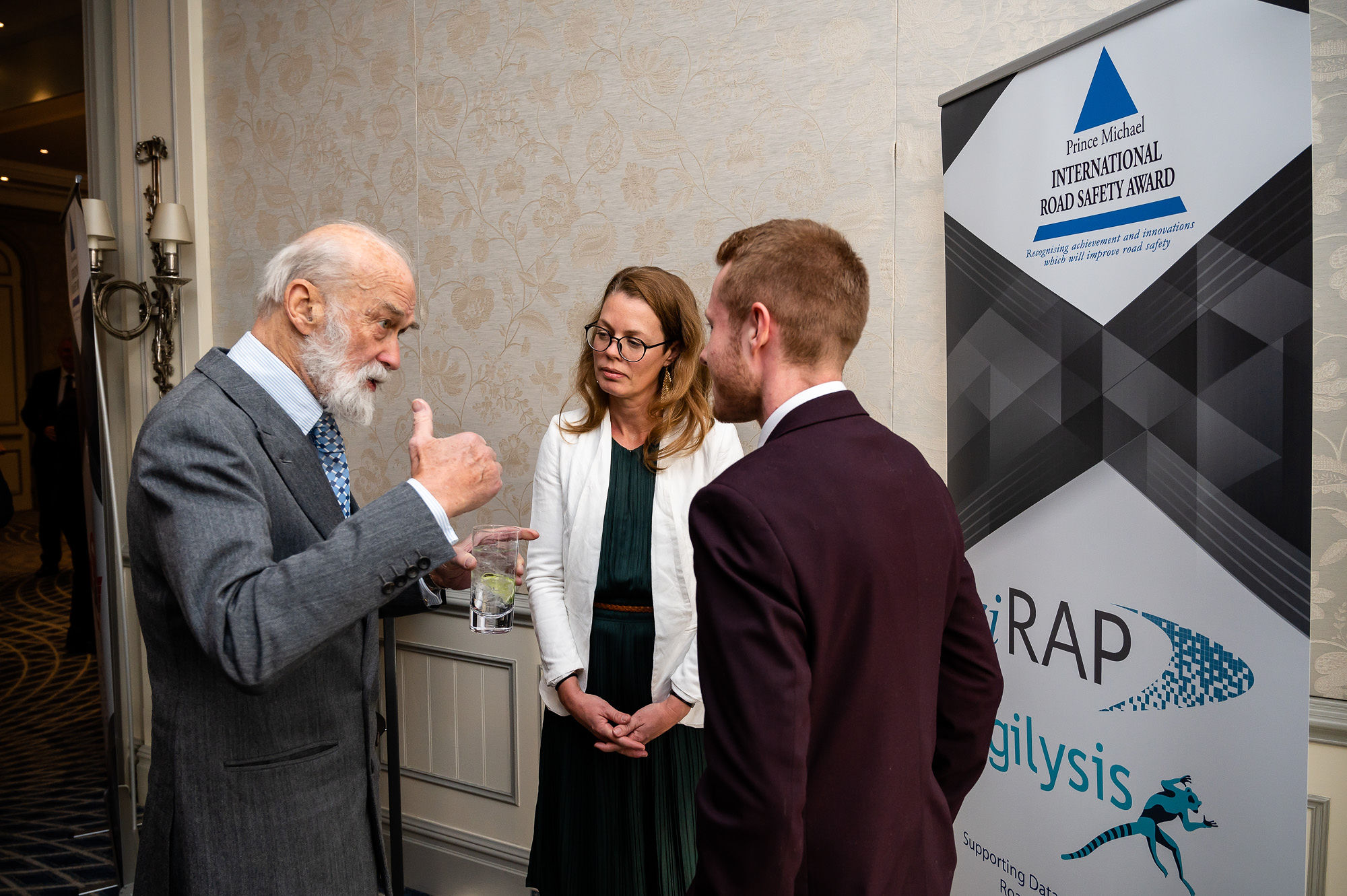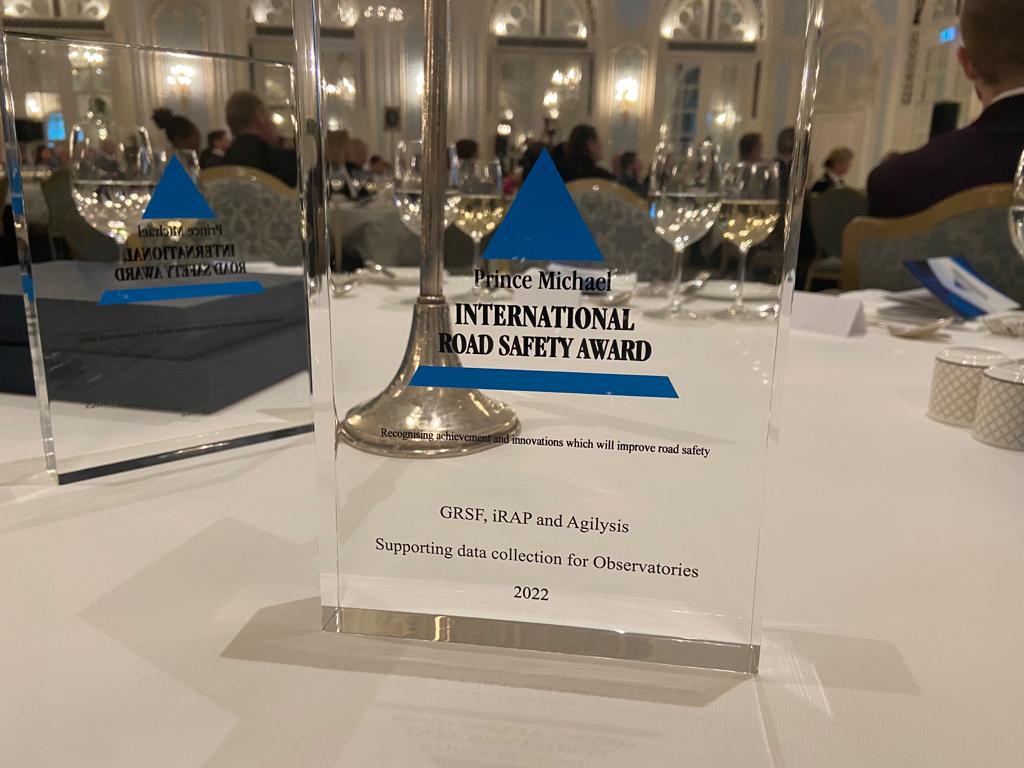
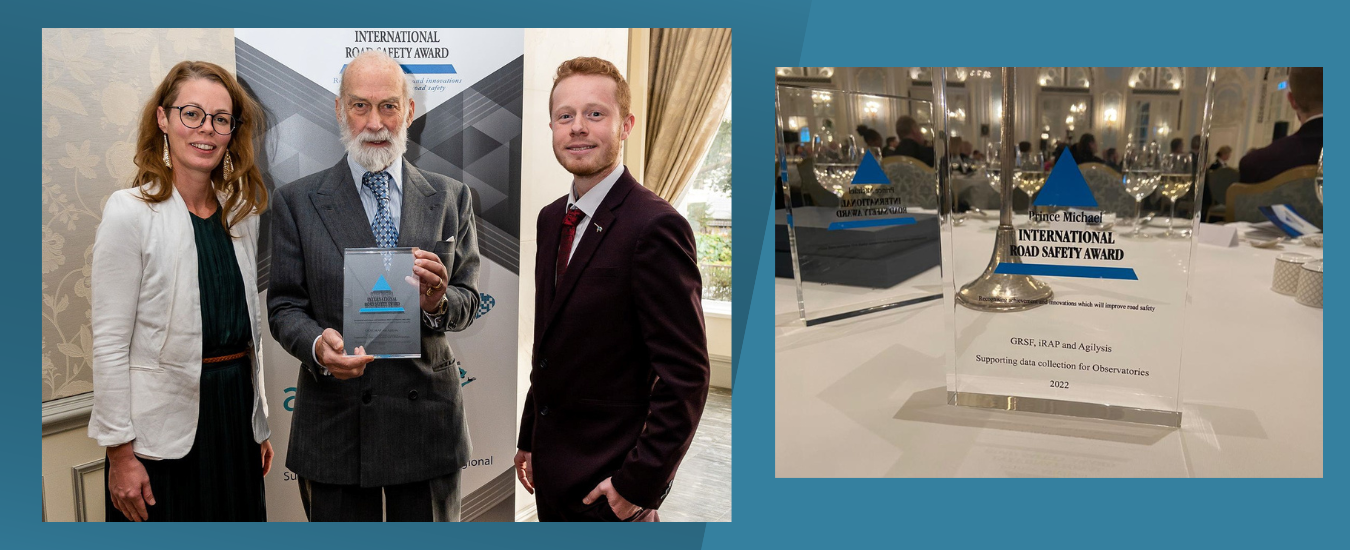
Crédit photo (ci-dessus et ci-dessous) : Photographie de Chris Fossey
Un projet novateur, utilisant l'imagerie satellitaire pour comprendre la sécurité du réseau routier, a été reconnu par Prix internationaux de sécurité routière Prince Michael.
Avec le financement du Fonds mondial pour la sécurité routière de la Banque mondiale (GRSF), iRAP et Agilysis a mené à bien un projet de recherche et développement novateur visant à exploiter des sources de données innovantes pour la sécurité routière en Afrique, en appui à l'Observatoire africain de la sécurité routière (ARSO).
De nouvelles sources de données d'imagerie satellite et de rue ont été combinées avec des approches d'apprentissage automatique de pointe pour cartographier où se produisent 75% de déplacements routiers au Kenya et en Éthiopie.
Le projet a également permis de développer une technologie de détection de la vitesse des véhicules, du flux de circulation et d'autres caractéristiques routières essentielles à la mesure et au suivi des indicateurs de sécurité routière.
La collecte de données de sécurité pertinentes représente un défi évident dans de nombreux pays ; le faire de manière cohérente et comparable d'un pays à l'autre est encore plus difficile.
Agilysis a exploité diverses données participatives et ouvertes provenant de différentes plateformes, ainsi que des images satellites de la plateforme ARD de MAXAR, pour évaluer plus d'une douzaine d'attributs routiers différents.
En décernant ce prix prestigieux au projet, les juges ont déclaré : “ Il s'agit d'un projet extrêmement novateur et révolutionnaire pour ceux qui travaillent dans les pays à revenu faible et intermédiaire, qui s'appuie sur des initiatives existantes ayant prouvé leur efficacité pour améliorer la sécurité routière dans le monde entier. ”
À propos de cette distinction, Richard Owen, PDG d'Agilysis, a déclaré : “ Ce projet a permis de concrétiser plusieurs années de recherche et développement afin de mettre au point une approche applicable à grande échelle. Nous disposons désormais des outils et de l'expertise nécessaires pour réaliser des analyses rapides des réseaux nationaux et identifier les principaux éléments de sécurité. ”
iRAP, Le responsable International Road Assessment Programme, qui a supervisé le projet et évalué les données de sortie, a établi que plusieurs indicateurs clés étaient mesurés avec précision et cohérence, reconnaissant ainsi la pertinence de l'approche. accréditation sous leur AiRAP programme.
Commentant les résultats du projet, James Bradford, directeur technique mondial de iRAP, a déclaré : “ Nous nous efforçons d’aider les gouvernements nationaux et les observatoires régionaux à collecter des données essentielles pour orienter les investissements. Les nouvelles approches explorées dans le cadre de ce projet constituent un progrès majeur dans le développement des données pour les indicateurs nationaux et le soutien aux objectifs volontaires des Nations Unies. ”
Grâce aux techniques avancées de vision par ordinateur, le projet a dépassé le stade des indicateurs nationaux et a produit des données au niveau routier sur les treize attributs suivants :
- Vitesse moyenne de fonctionnement du véhicule ;
- Vitesse de fonctionnement du véhicule au 85e percentile ;
- Trafic journalier annuel moyen (TJAM) ;
- Utilisation des terres ;
- Type de zone ;
- Limitation de vitesse;
- Courbure;
- Séparation des voies de circulation ;
- Présence piétonne ;
- Aménagements pour passages piétons ;
- Signalisation pour passage piéton ;
- Éclairage public; et
- Type d'intersection.
Ce projet a été rendu possible grâce au partenariat avec MAXAR et les innovations de leur plateforme Analysis Ready Data (ARD) qui ont facilité l'accès aux données d'observation de la Terre pertinentes. Les piles d'images prétraitées d'ARD ont permis à l'équipe de recherche d'acquérir des données à partir de cartes géospatiales très précises, réduisant ainsi le gaspillage et augmentant considérablement l'efficacité du processus d'analyse des images.
Suite à l'achèvement du projet à l'été 2023, cette approche a déjà été utilisée par Agilysis pour fournir des données à des clients travaillant en Amérique du Sud, en Afrique, en Asie du Sud et en Océanie.
– se termine –
Contacts médias :
Agilysis
Dan Campsall, président
Courriel : dan.campsall@agilysis.co.uk
Téléphone : +44 1295 731 812
Richard Owen, PDG
Courriel : richard.owen@agilysis.co.uk
Téléphone : +44 1295 731 815
iRAP
James Bradford, directeur technique mondial
Courriel : james.bradford@irap.org
À propos d'Agilysis
Agilysis a été fondée par une équipe expérimentée, forte de près de vingt ans d'expérience dans le domaine de la sécurité des transports. Alliant expertise en recherche, en politiques publiques et en pratique, et s'appuyant sur l'analyse de données massives et des approches novatrices, Agilysis contribue à la recherche internationale de pointe et propose des services de conseil et de conception d'interventions fondés sur des données probantes issues de diverses disciplines des transports et de la santé. Pour en savoir plus : https://agilysis.co.uk/
À propos de iRAP
iRAP est une organisation caritative enregistrée qui œuvre pour un monde sans routes dangereuses. Présente dans plus de 100 pays, elle collabore avec les gouvernements, les banques de développement, les clubs de mobilité, les organismes de recherche et les ONG de sécurité routière afin de leur fournir gratuitement les outils, les systèmes et les formations nécessaires pour améliorer la sécurité routière. La méthodologie d'évaluation par étoiles de iRAP offre une mesure simple et objective du niveau de sécurité intrinsèque de la route pour les automobilistes, les motocyclistes, les cyclistes et les piétons. Une route à 1 étoile est la moins sûre, tandis qu'une route à 5 étoiles est la plus sûre. L'organisation a contribué à améliorer la sécurité de plus de 19 000 milliards de dollars d'investissements dans les infrastructures, a évalué la sécurité de plus de 1,3 million de kilomètres de routes, cartographié les risques sur plus de 1,6 million de kilomètres et formé plus de 54 000 personnes à travers le monde. iRAP est le programme-cadre des programmes régionaux d'évaluation des routes, notamment EuroRAP, ChinaRAP, AusRAP, usRAP, KiwiRAP, IndiaRAP, BrazilRAP, South Africa RAP, ThaiRAP et MyRAP, et est soutenu financièrement par FIA Foundation et le Fonds mondial pour la sécurité routière. https://irap.org/
À propos de l'Observatoire africain de la sécurité routière
L’initiative de l’Observatoire africain de la sécurité routière (ARSO) a été lancée en 2018. Son objectif principal est de constituer une base de données solide permettant de suivre les performances de l’Afrique en matière de sécurité routière et d’améliorer la prise de décision. Pour en savoir plus, consultez le site web. https://ssatp.org/topics/african-road-safety-observatory