
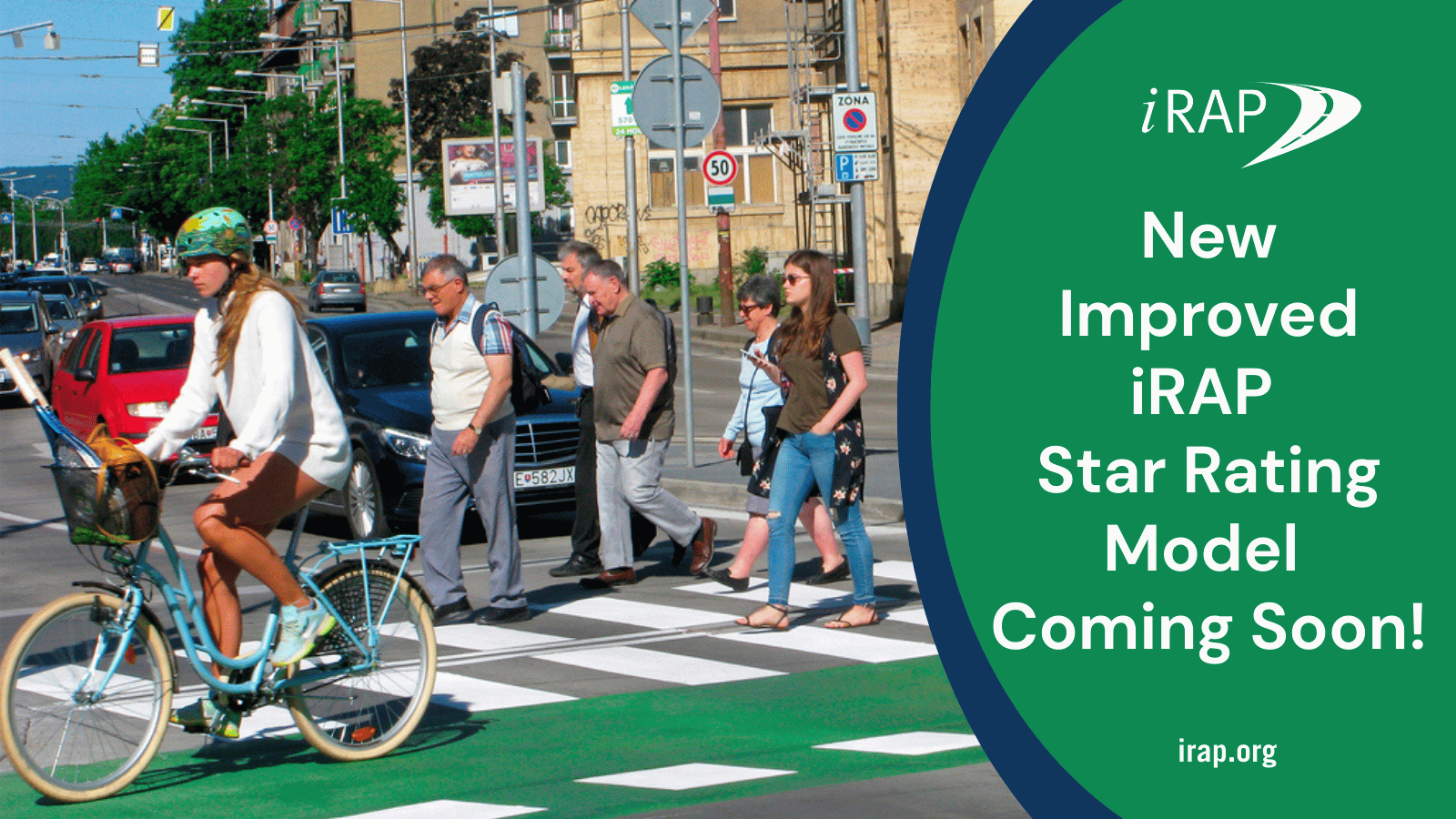
Grâce aux efforts de nos partenaires dans le monde entier, la méthodologie d'évaluation par étoiles de iRAP a servi de base aux évaluations de sécurité routière dans plus de 140 pays, contribuant à des améliorations routières de niveau 3 étoiles ou supérieur qui transforment les déplacements des piétons, des cyclistes, des motocyclistes et des occupants de véhicules à travers le monde.
S’appuyant sur les dernières données mondiales concernant les risques d’accidents, le modèle d’évaluation par étoiles actuel de iRAP (version 3.02) est en cours de mise à jour. Le nouveau modèle (version 3.10), élaboré avec l’aide d’experts et basé sur les recherches les plus pointues en matière de sécurité routière, sera disponible en ligne en mai 2026 et accessible via la plateforme en ligne de iRAP, ViDA.
Pourquoi le modèle change
iRAP s'engage à faire en sorte que ses méthodologies reflètent les recherches, les données probantes et l'expérience les plus récentes de ses partenaires dans l'utilisation des outils iRAP à travers le monde.
L'introduction de la version 3.10 contribue directement à Décennie d'action des Nations Unies pour la sécurité routière et le Décennie des Nations Unies pour le transport durable en proposant un cadre plus rigoureux et fondé sur des données probantes pour protéger les usagers vulnérables de la route et favoriser des réseaux de transport plus sûrs et plus équitables.
La version 3.10 est le fruit d'un examen approfondi mené sur cinq ans sur les recherches sous-jacentes aux méthodologies iRAP, sous la direction de Comité technique mondial iRAP. Les principaux facteurs de ce changement sont les suivants :
- Dernières données mondiales : Intègre les dernières recherches et données mondiales sur les risques d'accident.
- Alignement sécurisé du système : Aligne les facteurs de risque et les liens de causalité entre les blessures et les principes du système de sécurité.
- Priorité aux usagers vulnérables de la route (UVR) : Améliore la précision des évaluations des risques, notamment pour les piétons et les cyclistes, et dans une moindre mesure pour les motocyclistes.
- Résultats solides : Garantit que les évaluations restent robustes, reproductibles et alignées sur les résultats réels en matière de blessures.
Principaux changements
La mise à jour apportera plusieurs améliorations, notamment :
- Principales mises à jour concernant les utilisateurs virtuels : Des changements importants ont été apportés aux modèles de piétons et de cyclistes, notamment un nouveau type de collision “ passage pour cyclistes ”.
- Facteurs de risque détaillés: Mise en œuvre d'incréments de vitesse de 1 km/h et d'incréments de 1 000 véhicules par voie pour le flux de circulation externe.
- Bande unifiée : Un système de notation par étoiles cohérent pour les modèles piétons et cyclistes afin de garantir une interprétation uniforme.
- Note zéro étoileUne nouvelle zone ‘ zéro étoile ’ pour aider à différencier les tronçons de route à très haut risque et à les prioriser pour les travaux d'entretien.
- Évaluation décimale par étoiles : Une compréhension plus fine et nuancée de la sécurité routière qui dépasse les seuils traditionnels des étoiles.
- Fonctionnalité de vitesse de fonctionnement : Les nouvelles fonctionnalités de ViDA permettent aux utilisateurs d'attribuer des étoiles en se basant uniquement sur les vitesses de fonctionnement.
Impact sur les évaluations par étoiles
La transition vers la version 3.10 aura un impact sur le traitement et la production de rapports de données, notamment :
- Format des données : La version 3.10 requiert un format de données d'importation différent. Une nouvelle Spécifications du fichier à télécharger Une version sera publiée, et un outil de conversion sera fourni pour faciliter la transition.
- Contrôle des données : Les évaluations existantes réalisées avec la version 3.02 ne seront pas automatiquement mises à jour dans ViDA. Les utilisateurs peuvent choisir de conserver leurs résultats actuels ou de les relancer avec la version 3.10.
- Précision technique : Ce modèle offre une vision plus précise des risques, permettant ainsi de mieux cibler les améliorations en matière de sécurité.
- Évolution du système de notation par étoiles : Le classement par étoiles de certains tronçons de route peut évoluer. En règle générale, l'obtention d'une note de 3 étoiles ou plus pour les piétons et les cyclistes nécessitera des infrastructures de protection renforcées ou des limitations de vitesse.
- Codage et mesure : Les mises à jour comprennent des catégories révisées (par exemple, la qualité des trottoirs) et des règles de mesure ajustées, comme la mesure de la distance entre le trottoir et la bordure.
- Contraintes de comparaison : En raison des modifications importantes apportées aux modèles de cyclistes et de piétons, les résultats des versions 3.02 et 3.10 ne sont pas directement comparables pour ces usagers de la route. Les modifications apportées au modèle de motos sont relativement limitées ; toutefois, la comparaison des résultats des deux versions est déconseillée, car les mises à jour auront un impact sur le classement par étoiles de certaines configurations de routes et d’intersections.
Prochaines étapes
La version 3.10 sera disponible sur ViDA en mai 2026. Aucune action n'est requise pour le moment.
Pour vous aider à comprendre ces changements, nous avons publié :
- Note explicative concernant la mise à jour du modèle d'évaluation par étoiles iRAP : Ce document détaille les modifications apportées aux modèles de risque d'accident, aux facteurs de risque et aux directives de codage.
- Guide de référence de la méthodologie iRAP : Ce guide de référence consolidé décrit en détail les modèles iRAP et les facteurs de risque, ainsi que les preuves qui les sous-tendent.
- Foire aux questions (FAQ): Réponses aux questions techniques et de gestion des données courantes.
Dans les prochains mois, iRAP publiera les documents de spécification pour la version 3.10, y compris des versions mises à jour de Spécifications du fichier à télécharger, Manuel de codage iRAP et le Manuel de notation et de planification des investissements iRAP.
Avant le lancement prévu en mai, nous vous recommandons de consulter la documentation fournie.
Nous vous tiendrons régulièrement informés du lancement de la mise à jour du modèle et organiserons une série de webinaires d'information afin de vous assurer une préparation optimale à cette transition.
Restez à l'affût des annonces de webinaires à venir !
Les utilisateurs de ViDA seront informés par e-mail du lancement de la version 3.10 de ViDA.
Pour obtenir de l'aide concernant vos projets en cours ou la gestion de vos données, veuillez contacter support@irap.org.
Remerciements
Le développement et la publication de la version 3.10 ont été rendus possibles grâce au soutien et à la collaboration des nombreux partenaires et contributeurs du iRAP. Nous remercions chaleureusement le FIA Foundation pour son engagement constant à financer et à faciliter le déploiement mondial des outils du iRAP, notamment ViDA. Nous remercions également nos partenaires d'innovation et les centres d'excellence pour leur expertise technique et leurs contributions à la recherche appliquée ; les membres du Comité technique mondial pour leurs conseils, leurs relectures et leur rôle garant de l'intégrité méthodologique ; ainsi que la Commission européenne et UKRI pour leur soutien à travers des initiatives de recherche collaborative, dont le projet PHOEBE. Leur leadership et leur expertise collectifs garantissent que les modèles du iRAP restent fondés sur des données probantes, pertinents à l'échelle mondiale et alignés sur l'ambition commune d'éliminer les routes à haut risque dans le monde entier.
Les améliorations apportées au modèle ont été développées dans le cadre du projet PHOEBE, financé conjointement par la Commission européenne et UKRI, et ont fait l'objet de tests approfondis avec des données réelles. Le modèle piétonnier mis à jour a été déployé dans le cadre du programme d'évaluation des établissements scolaires (SR4S) en 2023 et est largement utilisé par les partenaires du monde entier, notamment les clubs FIA Mobility.