
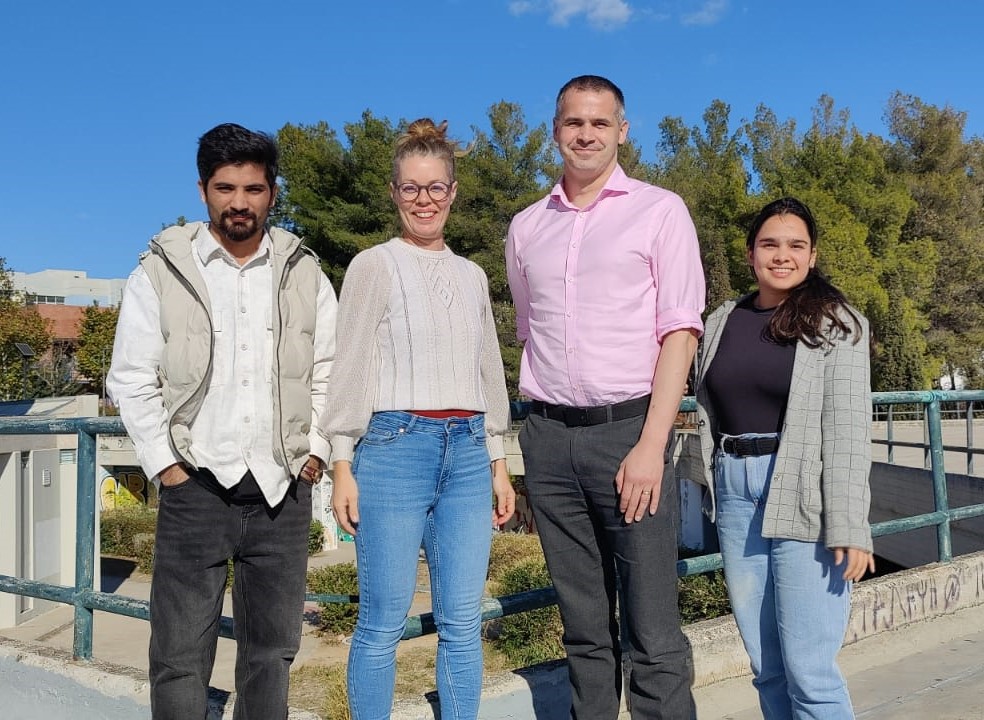
Sur la photo ci-dessus (de gauche à droite) : Mohammad Shahid (doctorant) ; Monica Olyslagers (responsable mondiale de l’innovation et spécialiste des villes chez iRAP) ; James Bradford (directeur technique mondial de iRAP) ; et Júlia Alves Porto (doctorante).
Nous sommes ravis d'accueillir les doctorants. Júlia Alves Porto et Mohammad Shahid dans le cadre de Projet Ivory
Júlia Alves Porto Elle possède une maîtrise ès sciences en génie des transports et génie civil.
Júlia travaillera sur le projet DC8, portant sur la cartographie proactive des risques et la gestion de la sécurité des infrastructures, et sera hébergée à la fois par NTUA et iRAP.
Dans le cadre de ce projet, Júlia se concentrera sur les objectifs suivants :
- Créer un cadre d'IA pour traiter, harmoniser, analyser et modéliser un ensemble de données disponibles et fournir des résultats sous forme de cartographie des risques et d'évaluations au niveau du réseau.
- Développer de nouveaux algorithmes d'IA pour la collecte d'attributs routiers, ainsi que des méthodologies pour évaluer et quantifier leur précision, adaptés aux applications réseau et incluant des données hybrides, par exemple collectées manuellement.
- Utiliser les données enrichies par l'IA pour élaborer une méthodologie de travail adaptée à la génération de données hybrides sur les attributs routiers et à l'amélioration de la cartographie proactive des risques.
Découvrez ici le travail de Julia sur le projet IVORY.
Mohammad Shahid Il est titulaire d'une maîtrise en ingénierie – informatique et technologie
Mohammad travaillera sur le projet DC12, portant sur l'harmonisation et l'application hybride des ensembles de données d'IA pour la sécurité routière, et sera hébergé par FPZ et iRAP.
Dans le cadre de ce projet, Mohammad se concentrera sur les objectifs suivants :
- Créer une taxonomie pour classer les ensembles de données générés par des algorithmes d'IA appliqués à des données provenant de diverses sources (par exemple, Lidar, imagerie 360°, géospatiales, télématique, imagerie satellite et gestion du trafic) et évaluer leur transférabilité
- Créer une nouvelle méthodologie pour harmoniser les ensembles de données générés à la fois par des algorithmes d'IA et par des approches manuelles
- Développer de nouveaux modèles hybrides d'évaluation de la sécurité routière qui combinent efficacement les avantages de diverses sources de données, afin de déterminer les risques d'accidents de la route et les risques de blessures graves pour les usagers motorisés de la route et les usagers vulnérables de la route.
Découvrez ici le travail de Mohammad sur le projet IVORY.
La semaine dernière, l'intégralité du réseau IVORY Horizon Europe “ IVORY ”, coordonné par TU Delft | Technologie, politique et gestion, réunis à NUTA à Athènes.
Cette réunion a permis à tous les doctorants, à leurs directeurs de thèse universitaires et industriels, de se réunir en personne et d'explorer les orientations que prendront leurs recherches.
Bienvenue Júlia et Muhammad !
À propos du projet IVORY : IVORY – ‘ L’IA au service de la Vision Zéro en matière de sécurité routière ’ est un réseau de doctorats industriels visant à développer un nouveau cadre pour l’intégration de l’IA dans la sécurité routière et à former une nouvelle génération de chercheurs de pointe dans ce domaine. L’objectif est de contribuer à l’atteinte de l’objectif 3.6 des Objectifs de développement durable des Nations Unies (réduire de moitié le nombre de décès sur les routes d’ici à 2030) et de la stratégie ‘ Vision Zéro ’ de la Commission européenne (éliminer les décès sur les routes d’ici à 2050). IVORY regroupe 4 bénéficiaires académiques et 8 bénéficiaires non académiques, ainsi que 8 partenaires associés, issus de 10 pays et spécialisés dans les domaines de l’ingénierie, des sciences des données et de l’éthique des technologies. Le réseau formera 15 chercheurs aux nouvelles applications responsables de l’IA pour l’assistance aux usagers de la route et la gestion de la sécurité des infrastructures, et créera une plateforme d’apprentissage et de mise en réseau durable.