
iRAP y el recién creado Fundación del Automóvil Club de Chile Nos conocimos recientemente en el Club Automovilístico de Chile (AACHI) en Santiago para debatir la colaboración para mejorar la seguridad vial y las iniciativas de movilidad sostenible en todo el país.
Julio Urzua, Director de Proyectos Globales de iRAP, y Morgan Fletcher, Gerente de Operaciones para Latinoamérica, se reunieron con el equipo de AACHI, integrado por: Maria Ignacia González (Directora Ejecutiva), Concepción Quintana (Directora) y Gonzalo Plaza (Presidente) de la Fundación ACCHI, y Carlos Larravide (Director General) y Álvaro Bravo (Gerente Comercial) de ACCHI.
La Fundación AACHI se dedica a promover una movilidad segura, equitativa y sostenible para todas las comunidades chilenas, y a difundir las mejores prácticas en transporte y movilidad.
Las conversaciones de la reunión se centraron en establecer un marco de colaboración entre las dos organizaciones sin ánimo de lucro para desarrollar, implementar y promover programas, proyectos e iniciativas que mejoren la movilidad y la seguridad vial.
Se exploraron oportunidades de cooperación para el diseño y la ejecución de proyectos conjuntos centrados en la investigación sobre seguridad vial, la evaluación de infraestructuras viales, el desarrollo de capacidades, la sensibilización de la comunidad, la recopilación de datos y la colaboración con iniciativas más amplias de los sectores público y privado.
En Chile, la Fundación ACCHI lidera la implementación de iRAP Programa Star Rating for Schools (SR4S), trabajando conjuntamente con los municipios, el Ministerio de Transportes y las comunidades escolares para crear entornos más seguros para los estudiantes.
Además, AACHI está involucrada en la primer piloto latinoamericano del Aplicación para la Participación Juvenil (YEA). YEA es una plataforma interactiva que permite a niños y jóvenes identificar y reportar fácilmente las condiciones de seguridad vial en las cercanías de sus escuelas, contribuyendo así a combatir la principal causa de muerte de su generación: los accidentes de tráfico.
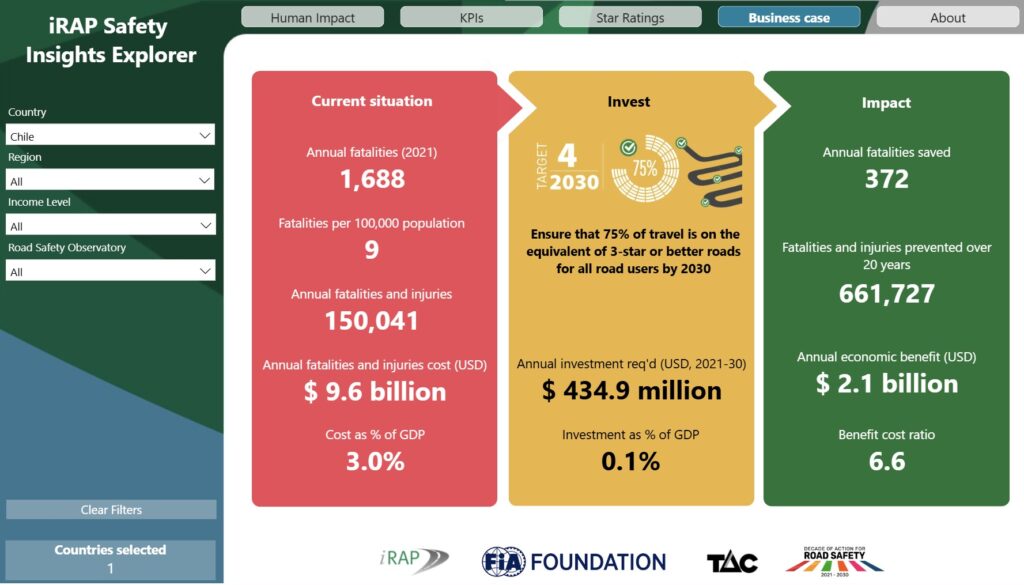
De acuerdo a Explorador de información sobre seguridad de iRAP, lograr el Objetivo 4 de la ONU de más de 75% de viajes en carreteras de 3 estrellas o mejores para todos los usuarios de la carretera en Chile para 2030 salvará un estimado de 372 vidas cada año, y 661,727 muertes y lesiones durante los 20 años de vida de los tratamientos de carreteras, con un beneficio económico de USD$2.1 mil millones – $6.60 por cada $1 gastado.