
A stakeholder information session recently kicked off plans to support safer roads in Armenia, with a package to build local road safety capacity and assessments of around 1,400km of key strategic roads to inform Asian Development Bank (ADB), World Bank and European Investment Bank (EIB) investment.
Jointly organised by the Armenia Ministry of Territorial Administration and Infrastructure (MTAI), the Asian Development Bank (ADB) and Asia-Pacific Road Safety Observatory (APRSO), with support from the Japan Fund for Prosperous and Resilient Asia (JFPR), the information session on 12 October engaged representatives from government agencies, law enforcement, academia, civil society, insurance, engineering and consulting firms, and other road safety practitioners.
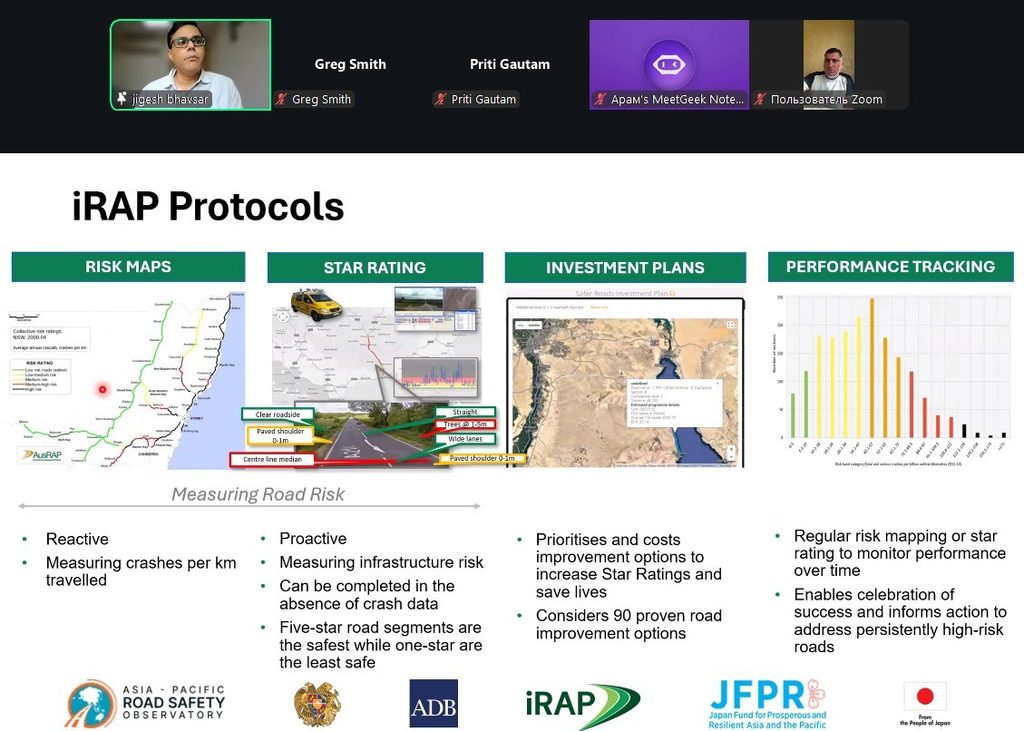
The session explored the iRAP methodology and tools, demonstrating how they can help decision-makers direct limited resources to locations where serious crashes are most likely to occur and prioritise infrastructure investment with the greatest potential to save lives.
It also highlighted the importance of moving from reactive, location-specific interventions towards a systematic, network-wide approach to road safety assessment and investment planning.
The session forms part of a wider programme of support to help eliminate high-risk roads in the country, bringing together three complementary workstreams:
- Capacity building: Delivery of an iRAP training and accreditation programme to equip practitioners with the knowledge and skills to apply the iRAP methodology and develop a network of Accredited Practitioners to perform high-quality road safety assessments. The programme will also support hands-on learning through planned road network assessments.
- Policy integration and the establishment of ArmeniaRAP: Support to the MTAI-led, multi-stakeholder working group to integrate iRAP assessments into Armenia’s road safety action plan and towards the development of a locally led ArmeniaRAP Road Assessment Programme. This includes embedding risk-based assessments into national planning, design and investment processes, with measurable road safety performance targets, such as achieving 3-star or better roads by 2031.
- Road safety engineering guidance: Technical support to adapt ADB’s Star Ratings for Road Safety Audit manual, developed for the Central Asia Regional Economic Cooperation (CAREC) region, to Armenia’s national context. A dedicated one-day technical workshop will support this work, alongside efforts to strengthen national guidance for network-wide road safety assessment and infrastructure risk management.
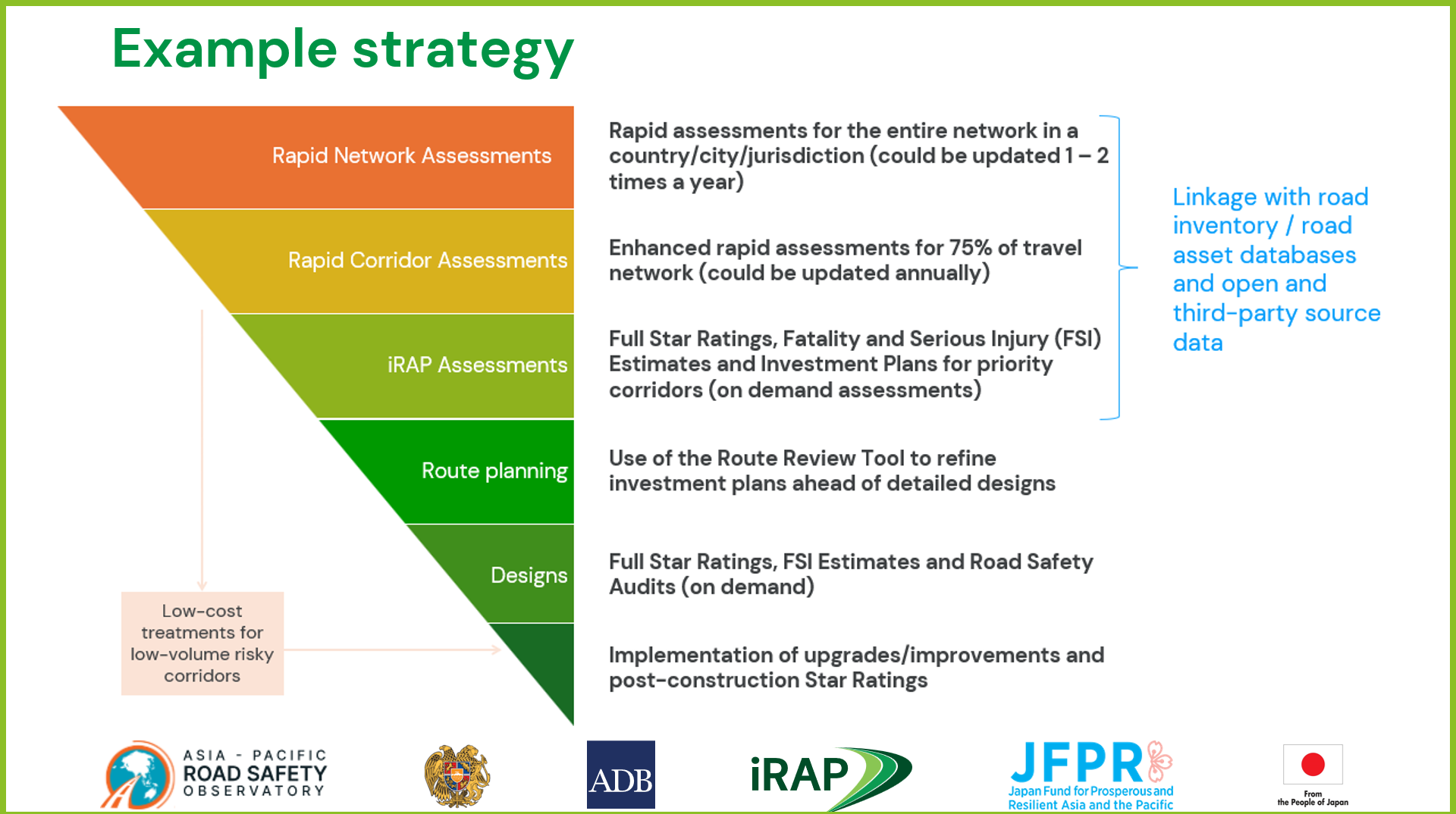
In parallel, a proposed iRAP assessment of approximately 1,400 km of interstate highways will identify high-risk sections, provide Star Ratings for different road users and develop Safer Roads Investment Plans (SRIPs) to prioritise cost-effective infrastructure improvements. The assessment is also expected to involve local institutions and practitioners, supporting the longer-term development of national technical capacity.
Together, these activities aim to strengthen Armenia’s capacity to assess and address road infrastructure risk, optimise development bank investment, and translate international road safety best practice into practical guidance for local engineers and decision-makers.
The longer-term vision is to institutionalise proactive road safety management through ArmeniaRAP, enabling continuous monitoring and improvement of road network safety performance.
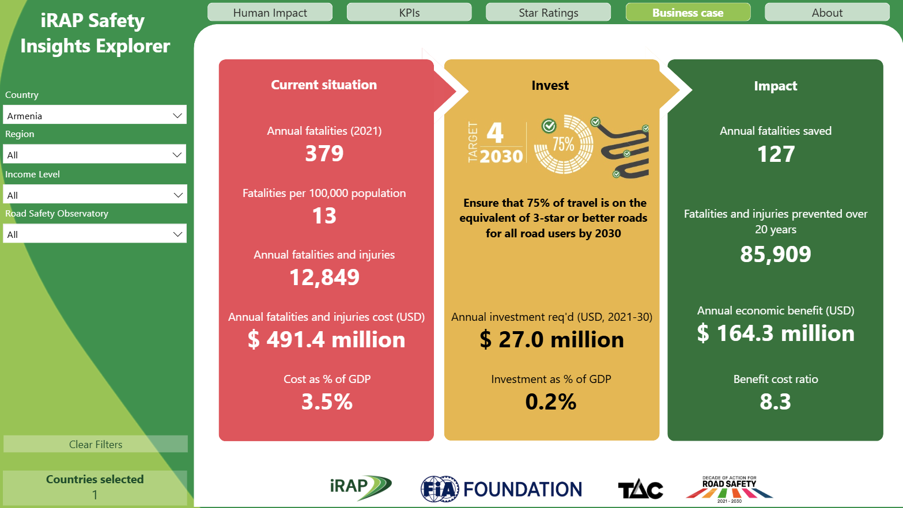
According to iRAP’s Safety Insights Explorer, achieving UN Target 4 for greater than 75% of travel on 3-star or better roads for all road users in Armenia by 2030 stands to save an estimated 85,909 fatalities and injuries over the 20-year life of road treatments with an economic benefit of US$164.3 million – $8.30 for every $1 spent.
Lead image credit: Melek, Pexels