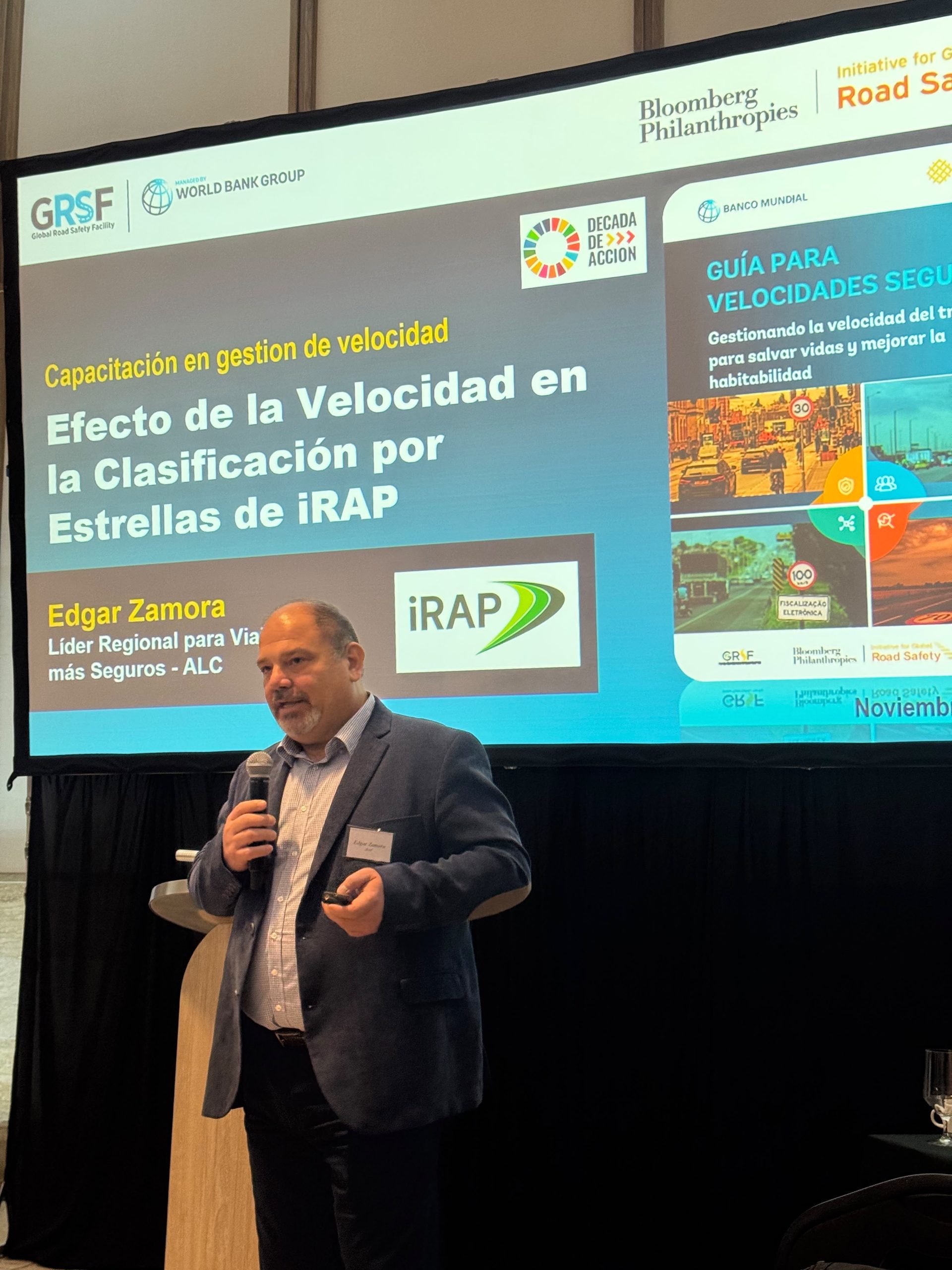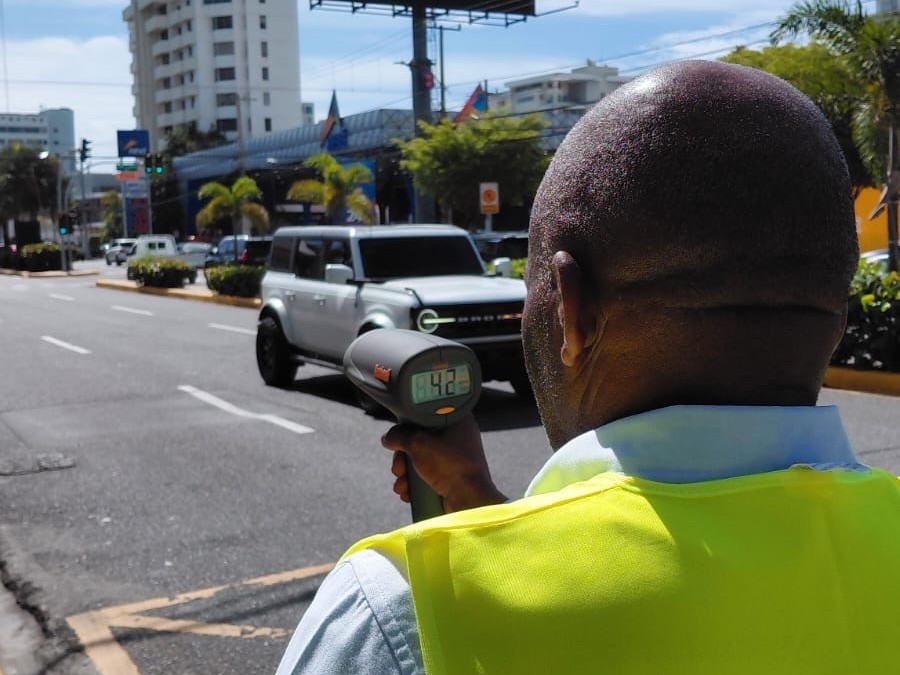
iRAP joined 30 international road safety experts and Dominican Republic stakeholders for a specialised training workshop on Speed Management, led by the World Bank and its Global Road Safety Facility (GRSF), from 3–5 November in Santo Domingo.
Edgar Zamora, iRAP’s Safer Journeys Lead for the Americas, presented on the Effect of Speed on iRAP Star Ratings, highlighting how vehicle speeds influence road infrastructure risk and the importance of speed management in designing and operating roads to protect all road users.
The three-day programme aimed to strengthen technical capacity to address one of the most significant determinants of crash risk and severity, and trauma outcomes: vehicle speed.
With expert presentations by representatives of World Bank, the National Institute of Traffic and Land Transportation (INTRANT), General Directorate of Traffic and Land Transportation Safety (DIGESETT), the Pan American Health Organization (PAHO), Bloomberg Initiative for Global Road Safety, iRAP, and the Inter-American Development Bank (IDB), the workshop brought together decision-makers and professionals working in road safety, mobility and urban design, government road authorities and NGOs.
“Speed is much more than a number on a road sign,” Edgar Zamora said. “It is a fundamental element in how we design, assess and manage roads for safety. Through iRAP’s Star Rating methodology, we can measure how speed interacts with road infrastructure, and importantly guide adjustments to reduce the risk of death and serious injury for pedestrians, bicyclists, motorcyclists and vehicle occupants.
“When speed goes down, the safety stars go up,” he said. “The challenge is to ensure that road design, speed limits and operating conditions are aligned to deliver roads that meet the minimum 3-star global safety standard for all road users. Even where roads have relatively good geometric and pavement characteristics, high speeds combined with frequent access points, roadside hazards, unsafe intersections and the presence of vulnerable road users can create significant risks,” he said.
Taking Safe System principles into the field
The workshop combined technical presentations and theoretical modules with practical exercises, covering safe speed selection across different road environments, speed management strategies and action plans, infrastructure and road design, land-use planning, enforcement, vehicle technology, communications, and the collection and evaluation of speed data.
On the third day, participants undertook a field exercise, inspecting two locations and identifying and evaluating road safety risk factors using the Safe System approach. The practical activity provided an opportunity to apply the principles discussed during the training to real-world road environments and consider how infrastructure, operating speeds and the needs of different road users interact.
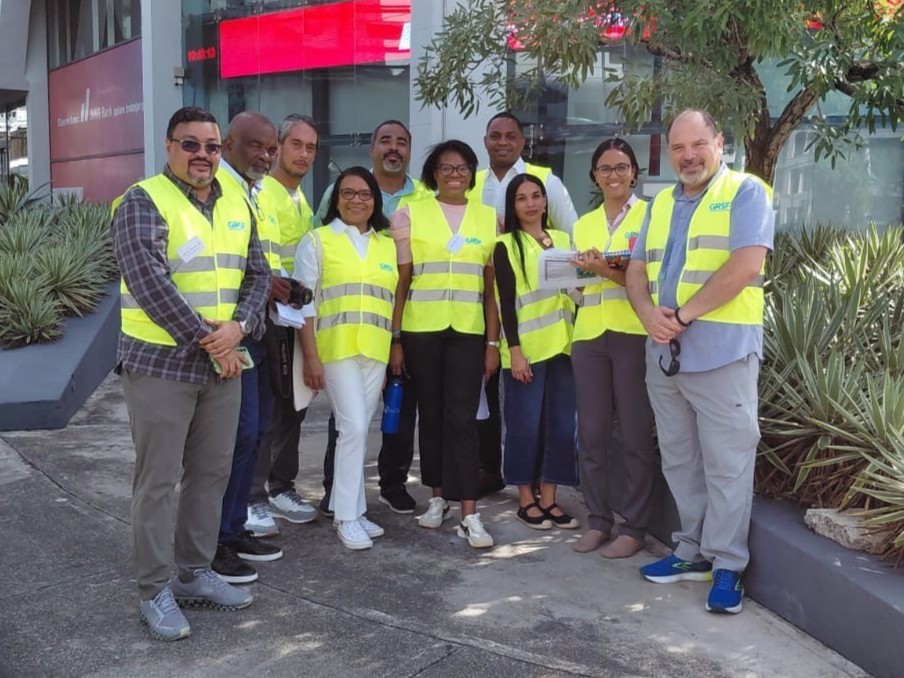
Edgar Zamora, iRAP’s Safer Journeys Lead for the Americas (far right) with workshop participants at the field training
International guidance for safer speeds
A key reference for the training was the World Bank and World Resources Institute’s (WRI) Guide to Safe Speeds: Managing Traffic Speed to Save Lives and Improve Livability.
It highlights the importance of combining appropriate speed limits with infrastructure treatments that encourage safe speeds, effective enforcement, vehicle technology and public communication.
The World Bank training is particularly relevant to the Dominican Republic, where busy urban streets, high-speed corridors, motorcycles, public transport, pedestrians and commercial activity frequently share road space. Ensuring that speeds are appropriate to these different environments is essential to protecting people travelling on and living alongside the road network.
Building capacity for a world free of high-risk roads
iRAP’s participation reinforces its commitment to supporting governments and road safety partners across Latin America and the Caribbean with practical tools, technical expertise and evidence-based approaches to safer road infrastructure.
By connecting speed management with infrastructure risk assessment, the workshop highlighted the importance of an integrated Safe System approach – one in which roads are designed for the speeds that can be safely accommodated, and where mistakes do not have to cost lives.
Through collaboration, technical capacity building and targeted investment in safer roads and speeds, countries can make significant progress towards achieving the UN Global Road Safety Performance Targets, including ensuring that all new roads are built to a minimum three-star safety standard for all road users and that more than 75% of travel takes place on roads that meet this standard by 2030.