
In the framework of the SABRINA – Safer Bicycle Routes in Danube Area project, online training was organised in cooperation iRAP. The participants from project partners’ organizations and relevant stakeholders attended the two-day workshop and were introduced to road infrastructure safety and the iRAP’s model with a focus on bicyclists’ safety.
Het project richt zich op de veiligheid van de weginfrastructuur voor fietsers, een van de meest kwetsbare weggebruikers. Het behandelt veiligheidsproblemen met betrekking tot fietsinfrastructuur op bestaande, geplande en ontbrekende fietsroutes die negen landen in de Donau-regio doorkruisen. Het doel is om de omstandigheden voor de veiligheid van de fietsinfrastructuur in de regio te verbeteren door de capaciteit van alle relevante nationale, regionale en lokale belanghebbenden te vergroten om op een veilige en duurzame manier fietsinfrastructuur aan te leggen en te verbeteren.
Road safety is a critical issue that needs to be addressed to ensure that all road users are safe. The iRAP model uses data about the features of a road, street or path to evaluate the risk of crashes for vehicles, motorcyclists, pedestrians and bicyclists.
During the first part of the webinar, Morgan Fletcher, Teamleider Operaties Latijns-Amerika en het Caribisch gebied, iRAP introduced participants to safe system and road infrastructure safety. “Each and every day 3,500 people are killed worldwide in road crashes. Road accidents are the leading cause of death for your people aged 5 to 29. There are also about 100,000 people that suffer life-changing injuries every day on the world’s roads. … Improving the safety of the roads is the single most significant achievable factor in reducing road trauma. … It is really important that we believe in safe mobility. … It requires more than building more roads to increase traffic flows, reduce travel times, reduce operating costs, etc. Safety has often been put to the side; it has been seen as some luxury add-on that you can do later. But in fact, safety has to be the single most important factor we consider when developing our transport system.”
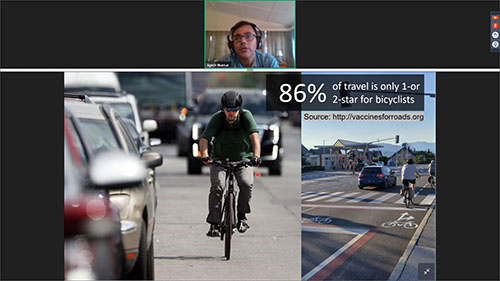
Jigesh Bhavsar, Technical Manager in IndiaRAP, presented iRAP in a global context. Worrying statistics based on the iRAP’s Vaccins voor de wegen data collections say that globally 86% of the roads are only 1- or 2-star for cyclists (out of possible 5 stars). Research shows that a person’s risk of death or serious injury is approximately halved for each incremental improvement in star rating. To understand how star rating works in practice, Jigesh showed practical usage of the iRAP’s online tool called Sterrenbeoordelingsdemonstrator which is freely available on iRAP’s website. We star rated a selected road section with mixed traffic in Slovenia. Participants were also encouraged to try and use the Demonstrator by themselves and star rate selected road sections.
The second part of the workshop focused even more on cyclists. Monica Olyslagers, Global Innovation Manager and Cities Specialist in iRAP, presented bike safety and the new CycleRAP-model. CycleRAP is a dedicated model for the evaluation of the safety of bicycling and light mobility. It identifies high-risk locations and provides data to help reduce crashes and improve infrastructure safety for these transport modes. Monica showed how the model can be used in practice. The CycleRAP model can be used independently or in conjunction with other RAP models and tools and other types of risk evaluation methods. It can be also combined with Star Rating for Schools model, which was presented by Rafaela Machado, Star Rating for Schools Global Coordinator. This model focuses on pedestrians and their safety, but it can also be combined with CycleRAP which will give us results on how safe is for kids to walk and cycle to and from school and provide the decision-makers and relevant stakeholders with the necessary data for infrastructure improvements and consequently better road safety for kids and other roads users.
The iRAP training was part of the training module in the framework of the SABRINA project. Training has also been provided as part of the SABRINA project on European Certification Standard developed by the European Cyclists’ Federation.
Read more about the SABRINA Project hier