
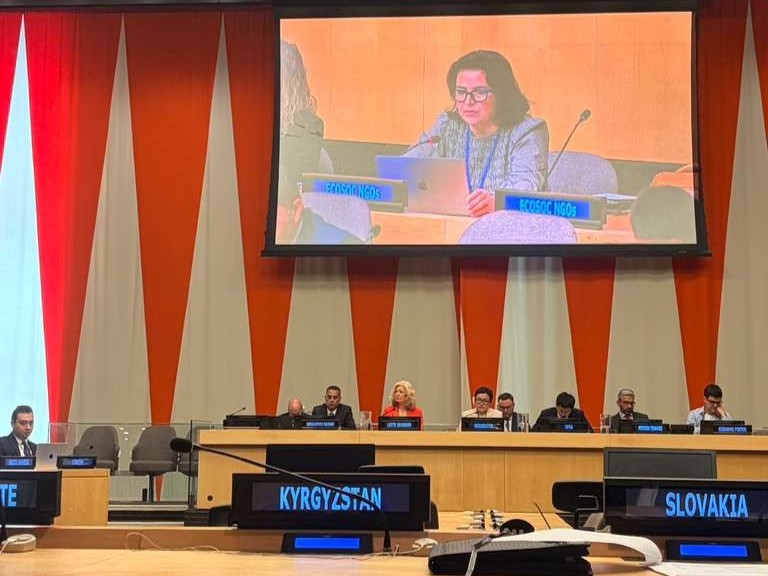
On 12 May, Samar Abouraad, iRAP’s Global Safer Journeys Specialist, addressed the Interactive Multi-Stakeholder Hearing in New York, and televised globally, as part of preparatory process for the upcoming United Nations (UN) High-Level Meeting on Improving Global Road Safety.
The hearing served as an inclusive platform for stakeholders to share their perspectives, experiences, best practices and actionable proposals to accelerate progress towards achieving the global goal of halving road traffic deaths and injuries by 2030, with a view to informing the High-Level Meeting on 20 and 21 July 2026 and its progress declaration.
The hearing brought together senior-level representatives of Member States and members of the UN specialized agencies, observers of the General Assembly, parliamentarians, representatives of local governments, relevant UN entities, non‑governmental organizations in consultative status with the Economic and Social Council, invited civil society organizations, philanthropic foundations, academia, medical associations, the private sector and broader communities. In doing so, it ensured the participation and voices of women, children, youth, Indigenous Peoples, people of African descent and persons with disabilities.
Samar’s three-minute address (viewable in the hearing recording at 01:18:10) shared the importance of safe road infrastructure to prevent road traffic deaths and injuries.
“iRAP is a global charity dedicated to creating a world free of high-risk roads. Its mission is to save lives by eliminating dangerous road infrastructure,” Samar said.
“Evidence-based assessments, safer road design and targeted investment strongly promotes the global target of achieving 3-star or better roads for all road users. Research behind the methodology shows that every incremental improvement in a road star rating can approximately halve the risk of death or serious injuries on a road.
“Safer infrastructure treatments such as median barriers, traffic calming, pedestrian crossings, sidewalks, bicycle lanes and safer intersections significantly reduce both the likelihood and severity of crashes – and sometimes these measures can be low cost ones.
“iRAP’s mission is not only to assess roads but to transform them into safer systems where human mistakes do not result in deaths or life-changing injuries. By upgrading roads to at least a 3-star standard, countries can dramatically reduce road trauma and move closer to the global target of halving road deaths and injuries,” she added.
Samar shared that iRAP has recently reached out to all heads of state through the UN Permanent Missions to alert them to the important role they can play, and to urge them to take part in the meeting and renew their commitment to halve road deaths and injuries in their countries. More than 40 countries have responded in support of the advocacy initiative
Achieving 3-star or better safer roads and streets for all road users stands to prevent more than 600,000 deaths and millions of injuries each year, thus achieving the Decade of Action target.
Despite growing political commitment and increasing evidence on effective measures, road safety remains an urgent development priority, a major public health problem and a social equity issue.
Each year, road crashes claim more than 1.19 million lives, a reduction of 5 per cent since 2010, but the progress still falls short of the pace required to meet the 2030 target. Ninety-two per cent (92%) of these deaths occur in low- and middle- income countries. Road traffic crashes remain the leading cause of death among children and young people aged 5-29 years.
Voor meer informatie:
- Watch the Multi-Stakeholder Hearing here (and Samar’s address at 01:18:10)
- Read more about the High-level Meeting, iRAP’s letter campaign to Heads of State and how partners can engage before, during and after the event hier.