
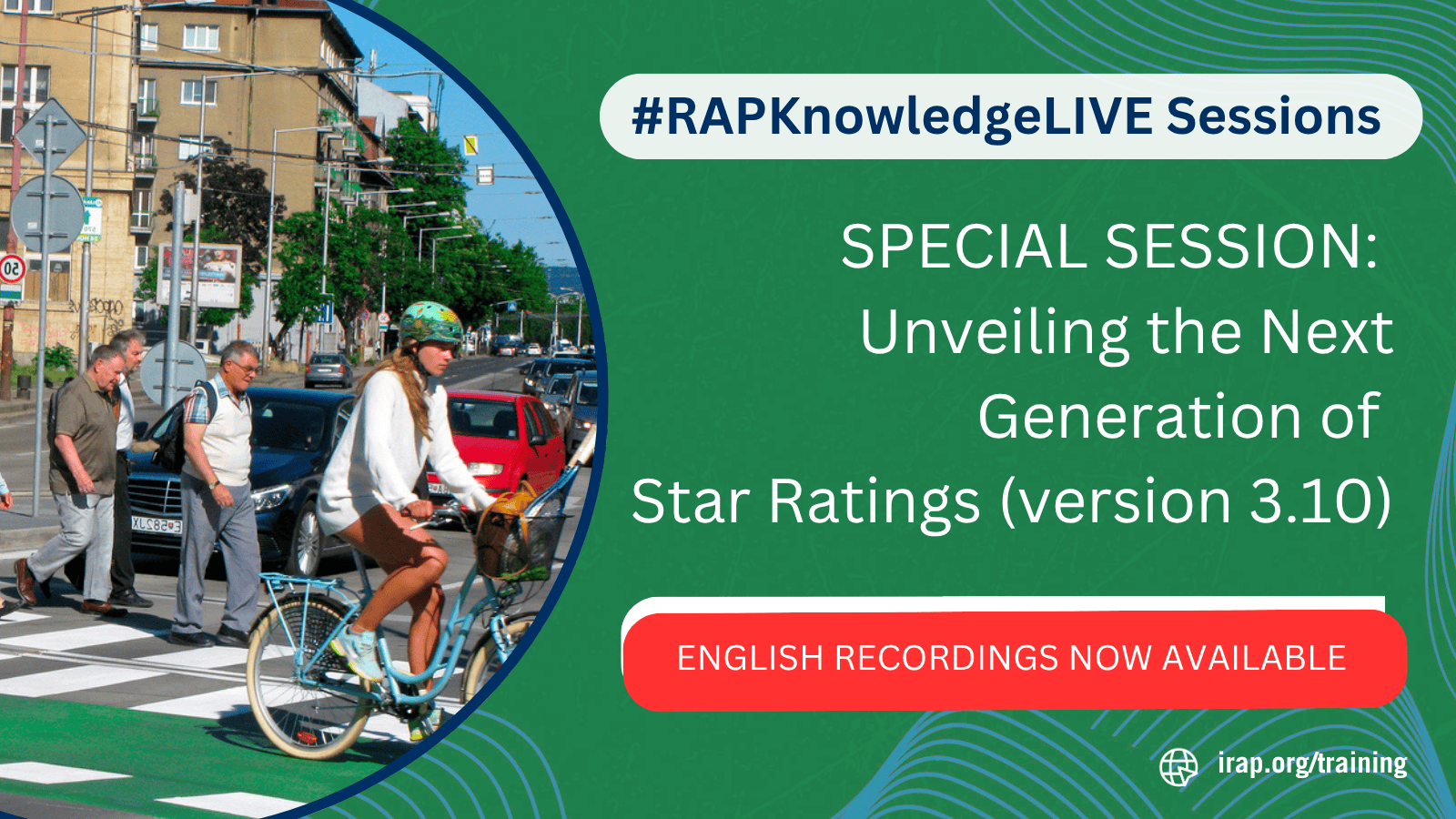
Des champions de la sécurité routière du monde entier se sont réunis la semaine dernière pour deux #RAPKnowledgeLive Sessions spéciales. Ces webinaires ont marqué un moment charnière dans le parcours vers la Décennie d'action des Nations Unies pour la sécurité routière, offrant un aperçu exclusif du nouveau modèle amélioré de notation iRAP : version 3.10.
Suite à un examen approfondi sur cinq ans mené par le Comité technique mondial iRAP, la version 3.10 devrait être lancée en mai 2026. Ces sessions ont fourni des informations essentielles aux autorités routières, aux ingénieurs et aux partenaires sur la façon dont le modèle évolue pour mieux protéger tous les usagers de la route.
Rattraper le retard : Regardez les enregistrements
Si vous avez manqué les sessions en direct en anglais ou si vous souhaitez revoir les détails techniques, les enregistrements et les supports de présentation sont désormais disponibles (des sessions en espagnol, portugais et français sont également prévues prochainement !).
-
Regardez l'enregistrement de la session 1 (Amérique du Nord, Europe, Afrique, Moyen-Orient)
- Regardez l'enregistrement de la session 2 (Asie, Australie-Pacifique)
-
Téléchargez la note explicative relative à la mise à jour du modèle de notation par étoiles iRAP : Ce document détaille les modifications apportées aux modèles de risque d'accident, aux facteurs de risque et aux directives de codage.
-
Téléchargez le guide de référence de la méthodologie iRAP : Ce guide de référence consolidé décrit en détail les modèles iRAP et les facteurs de risque, ainsi que les preuves qui les sous-tendent.
Principaux enseignements : Questions-réponses des sessions en direct
Pour vous aider à prendre une longueur d'avance dans cette transition, nous avons mis en lumière les questions les plus urgentes soulevées par la communauté mondiale lors des webinaires de la semaine dernière :
Quel est l’impact de la nouvelle notation “ zéro étoile ” sur nos données actuelles ?
L'introduction de Bande zéro étoile Ce système vise à identifier et à prioriser les tronçons routiers à très haut risque, auparavant classés dans la catégorie 1 étoile. Il permet ainsi de prendre des décisions d'investissement plus ciblées en mettant en évidence les zones où le risque est le plus aigu.
Quelles améliorations ont été apportées pour les usagers vulnérables de la route (UVR) ?
La version 3.10 apporte des améliorations majeures aux modèles piétons et cyclistes. Cela inclut une toute nouvelle fonctionnalité. Type d'accident de passage piéton pour cyclistes et des catégories de codage plus granulaires, telles que la distance précise entre les trottoirs et le bord du trottoir, afin d'améliorer la précision du modèle.
Peut-on mesurer de petites améliorations en matière de sécurité qui n'entraînent pas de changement d'une note entière ?
Oui. Avec le nouveau Évaluation décimale par étoiles, Les autorités peuvent désormais mesurer et communiquer plus clairement les améliorations progressives. Cela permet de constater l'impact des améliorations ciblées en matière de sécurité qui réduisent les risques même si la route conserve son niveau de sécurité actuel (classement par étoiles).
Quel impact cela aura-t-il sur nos projets en cours à ViDA ?
Les projets utilisant actuellement la version 3.02 resteront inchangés afin de garantir la cohérence. Cependant, la version 3.10 deviendra la nouvelle norme pour toutes les évaluations futures dans ViDA à partir de mai 2026. Un guide de transition est disponible pour aider les partenaires à comprendre les raisons des éventuelles différences de résultats entre les versions.
Nous avons mis à jour notre Document de questions fréquemment posées (FAQ) qui répond aux questions techniques et de gestion des données courantes, y compris les questions-réponses de ces sessions.
Prochaines sessions : Rejoignez-nous dans votre langue
Nous poursuivons ce déploiement mondial avec trois sessions dédiées à Espagnol, portugais et français. Ces webinaires aborderont le même niveau de détail technique que les sessions en anglais, adaptés aux contextes régionaux.
| Quelle région ? | Quelle langue ? | Date | Temps | Intervenants | Lien d'inscription Zoom |
| Afrique de l'Ouest/Centrale + Europe | Français | Lundi 6 avril |
11h00 UTC 13h00 CEST (Paris) 1200 WAT |
Nathalie Chiavassa, responsable des voyages plus sûrs (Afrique) – iRAP | Regardez ici |
| Amérique latine + Espagne | Espagnol | Lundi 6 avril |
15h00 UTC 09h00 CST (Mexique) 1000 COT 17h00 CEST (Espagne) |
Morgan Fletcher, responsable de l'équipe des opérations LAC – iRAP | Regardez ici |
| Brésil + Portugal | portugais | Mardi 7 avril |
13h00 UTC 1000 BRT 1400 OUEST (Portugal) / WAT (Angola) |
Morgan Fletcher, responsable de l'équipe des opérations LAC – iRAP et Gabriel Oliveira, stagiaire du projet de sécurité routière – iRAP | Regardez ici |
N'attendez pas le lancement en mai ! Réservez votre place dès aujourd'hui pour vous assurer que vous et/ou votre équipe êtes parfaitement préparés à la transition vers le modèle 3.10 !