
Le projet PHOEBE a franchi une étape importante avec la finalisation de son rapport final.‘Nouveaux modèles et environnements de simulation améliorés et matériel d'assistance à l'utilisateur (édition bêta)‘Le développement a mis en lumière le rôle fondamental des usagers vulnérables de la route dans la sécurité des environnements urbains, les nombreux obstacles à une évaluation adéquate de leur sécurité et l'importance des données.
Le financement de l'UE ‘Projet ’ Approches prédictives pour un environnement urbain plus sûr » (PHOEBE) Ce projet vise à améliorer la sécurité routière des usagers vulnérables, notamment ceux qui utilisent des modes de mobilité active et des trottinettes électriques. Il s'appuie sur les atouts des outils d'évaluation de la sécurité routière de iRAP et sur les technologies de simulation et d'intelligence artificielle d'AIMSUN pour proposer des outils de prédiction de la sécurité harmonisés, intégrés et de pointe à l'échelle mondiale, qui prennent en compte le sexe, l'âge et le niveau de capacité afin d'anticiper les besoins futurs en matière de mobilité.
Le rapport bêta est un livrable intermédiaire qui décrit l'état actuel du développement technologique. Il rend compte de la préparation et du développement des modèles améliorés, des environnements de simulation et des ressources d'aide à l'utilisateur, prêts à être testés sur les trois sites pilotes PHOEBE d'Athènes, de Valence et des West Midlands.
Plus précisément, cela comprend la préparation de plusieurs aspects en vue de leur intégration dans l'environnement de simulation de trafic AIMSUN, notamment :
- Modèles de changement de mode et de demande induite pour faciliter les résultats dynamiques, reflétant les fluctuations du flux et de la vitesse du trafic.
- Modèles comportementaux humains pour améliorer la compréhension des interactions des utilisateurs et des processus de prise de décision.
- Améliorations du modèle d'évaluation de la sécurité routière, notamment une segmentation des données plus précise et des évaluations dynamiques des risques basées sur la vitesse et les flux variables.
- Améliorations apportées au ‘AIMSUN Suivant’' Environnement de simulation, visant à améliorer la précision et le réalisme de la simulation.
- Procédures et stratégies d'intégration pour la représentation des changements de comportement et de la demande induite dans les scénarios de simulation, soulignant l'engagement du projet à relever les défis complexes de la mobilité urbaine.
De ces progrès, deux leçons essentielles se dégagent :
Les usagers vulnérables de la route (UVR) restent au cœur de la sécurité urbaine :
Il est désormais incontestable que les usagers vulnérables de la route (UVR) constituent la pierre angulaire de la sécurité en milieu urbain. Cependant, l'équipe du projet PHOEBE a rencontré de nombreux obstacles pour évaluer correctement leur sécurité. Ces obstacles vont de l'absence de données dédiées et de la nécessité d'améliorer les modèles pour ces usagers à un manque d'études dans des domaines spécifiques. Il reste encore beaucoup à faire en matière de sécurité des UVR. Le rôle de PHOEBE est de combler les lacunes du projet et d'en mettre en lumière d'autres pour la communauté de la sécurité routière.
Les données s'imposent comme un pilier fondamental :
Les données sont essentielles au projet PHOEBE, car elles sont au cœur du développement des modèles et des processus de calibration et de validation. Cependant, la gestion de la complexité des données, notamment en matière d'accès, de conformité et de traitement, représente un défi de taille. Les partenaires du projet recensent activement les sources de données et élaborent des lignes directrices afin d'optimiser leur utilisation dans le cadre du projet, favorisant ainsi une adoption et une applicabilité plus larges.
Un livrable ultérieur du projet PHOEBE présentera la documentation complète de chaque composant et les protocoles d'intégration.
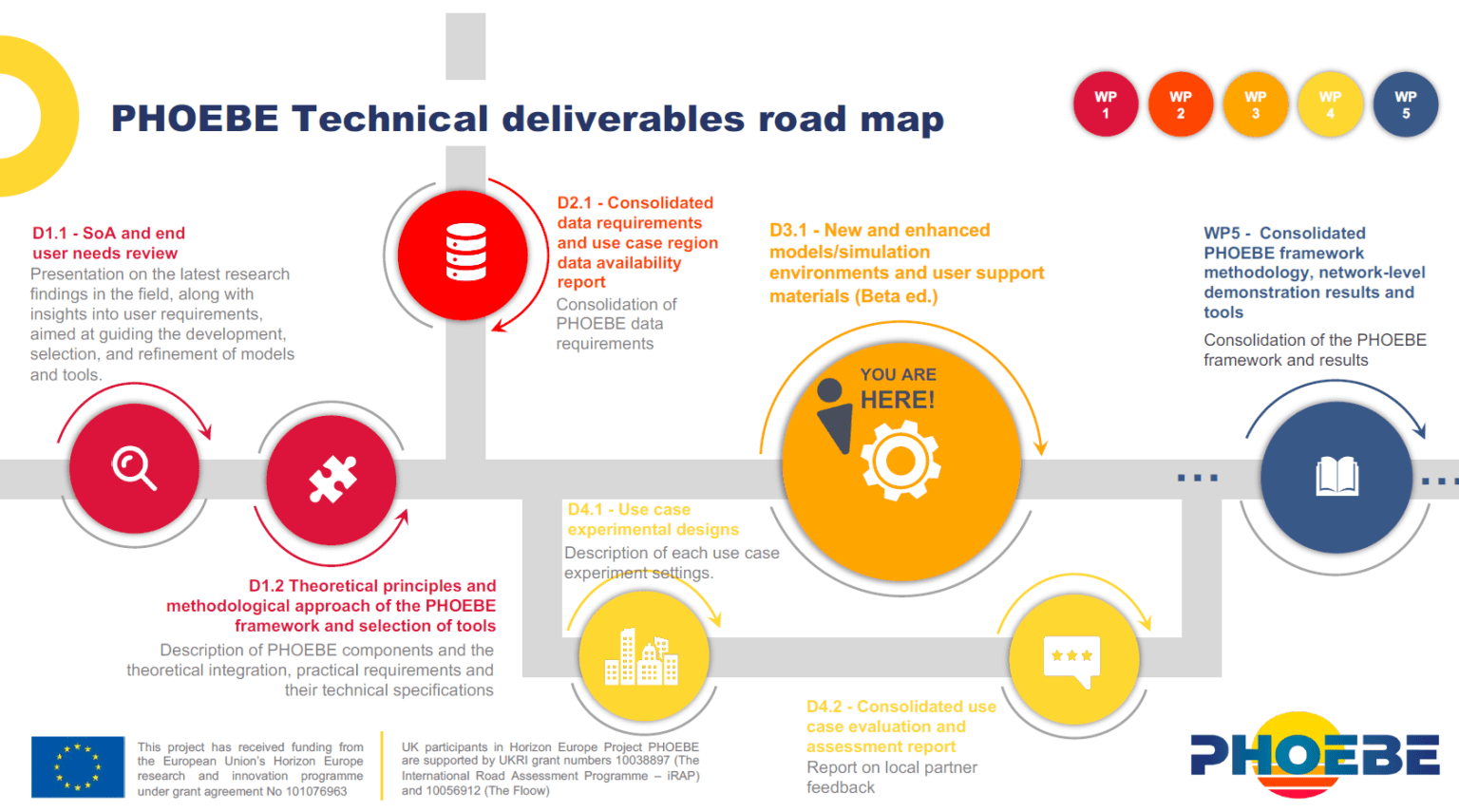
Suivez les progrès du projet PHOEBE
Pour en savoir plus, consultez le compte rendu de la récente réunion du consortium PHOEBE.