
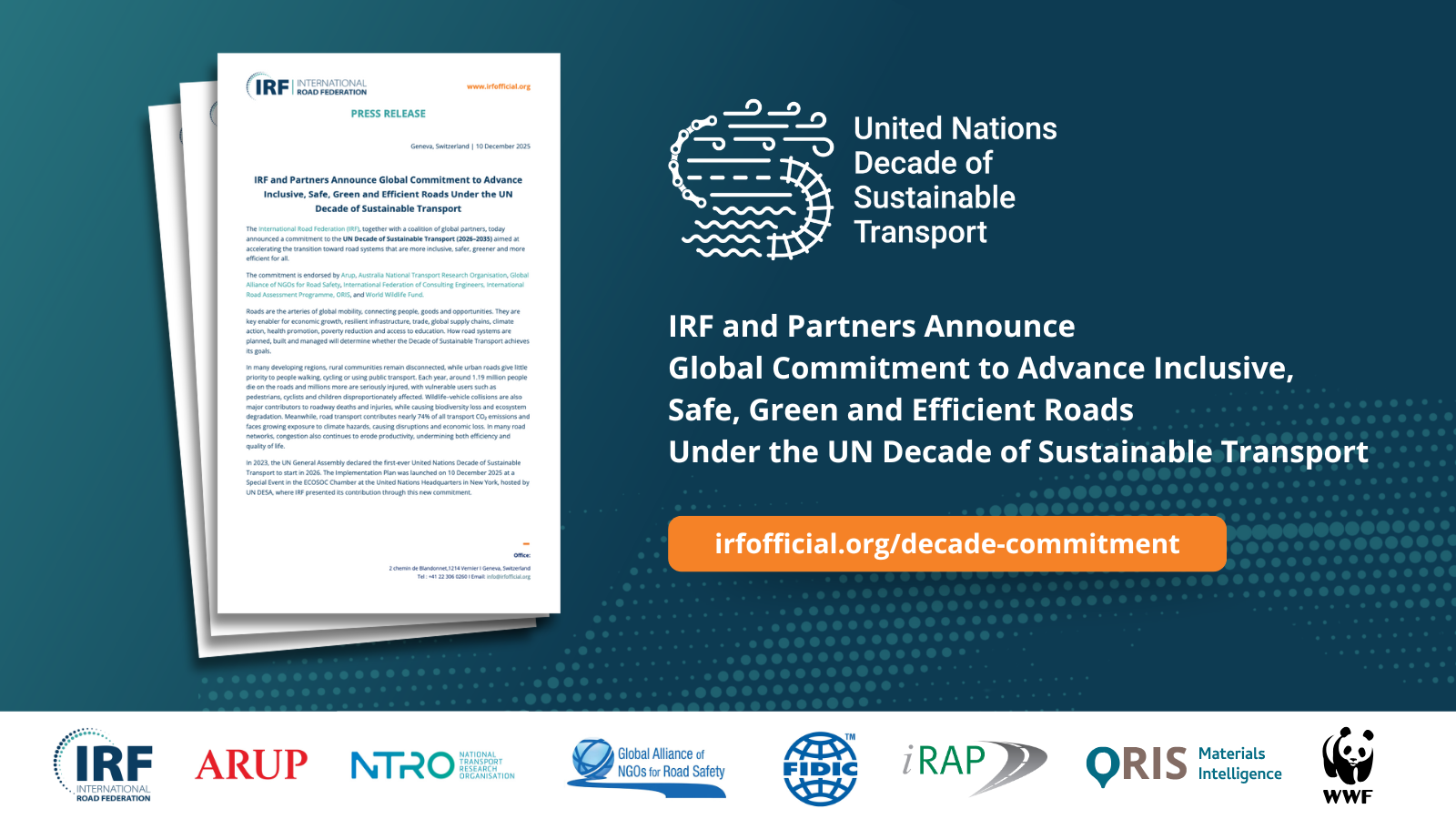
El Federación Internacional de Carreteras (IRF), junto con una coalición de socios globales, incluido iRAP, han anunciado hoy un compromiso con la Decenio de las Naciones Unidas (ONU) del Transporte Sostenible (2026-2035) Su objetivo es acelerar la transición hacia sistemas viales inclusivos, seguros, ecológicos y eficientes para todos.
El compromiso cuenta con el respaldo de Arup, Organización Nacional de Investigación del Transporte de Australia (NTRO), Alianza mundial de ONG para la seguridad vial, Federación Internacional de Ingenieros Consultores (FIDIC), iRAP, ORIS y Fondo Mundial para la Naturaleza.
Las carreteras son las arterias de la movilidad global, conectando personas, bienes y oportunidades. Son un elemento clave para el crecimiento económico, la resiliencia de la infraestructura, el comercio, las cadenas de suministro globales, la acción climática, la promoción de la salud, la reducción de la pobreza y el acceso a la educación. La forma en que se planifiquen, construyan y gestionen los sistemas viales determinará si el Decenio de las Naciones Unidas del Transporte Sostenible alcanza sus objetivos.
En muchas regiones en desarrollo, las comunidades rurales permanecen aisladas, mientras que las carreteras urbanas dan poca prioridad a quienes caminan, andan en bicicleta o usan el transporte público. Cada año, alrededor de 1,19 millones de personas mueren en las carreteras del mundo y millones más resultan gravemente heridas, afectando de manera desproporcionada a usuarios vulnerables como peatones, ciclistas y niños. Las colisiones entre vehículos y fauna silvestre también contribuyen significativamente a las muertes y lesiones en las carreteras, además de causar pérdida de biodiversidad y degradación de los ecosistemas. Mientras tanto, el transporte por carretera contribuye a casi 741 TP8T de todas las emisiones de CO₂ del transporte y se enfrenta a una creciente exposición a los riesgos climáticos, lo que provoca interrupciones y pérdidas económicas. En muchas redes viales, la congestión sigue erosionando la productividad, socavando tanto la eficiencia como la calidad de vida.
En 2023, la Asamblea General de las Naciones Unidas declaró el primer Decenio de las Naciones Unidas del Transporte Sostenible, que comenzaría en 2026. El Plan de Implementación se presentó el 10 de diciembre de 2025 en un evento especial en la Sala del ECOSOC en la Sede de las Naciones Unidas en Nueva York, organizado por el Departamento de Asuntos Económicos y Sociales de las Naciones Unidas (DESA), donde el IRF presentó este nuevo compromiso voluntario.
Este compromiso contribuirá a traducir la visión del Decenio en acciones concretas, proporcionando orientación estratégica y apoyo práctico a quienes planifican, desarrollan y gestionan estos proyectos. Su eje central es la serie Hojas de Ruta para el Cambio, que describirá acciones políticas, estándares y herramientas técnicas, prácticas replicables, innovación e indicadores de progreso para:
- Carreteras inclusivas que mejoren el acceso seguro a las zonas rurales, conecten a las comunidades aisladas con los servicios esenciales y reequilibren el espacio urbano para priorizar la movilidad activa y colectiva.
- Carreteras seguras en consonancia con los objetivos del Decenio de Acción de las Naciones Unidas para la Seguridad Vial, que incorporan principios e intervenciones de seguridad basados en la evidencia en la planificación, el diseño, la construcción, el mantenimiento y la operación.
- Carreteras ecológicas que promuevan la descarbonización y la resiliencia, facilitando el uso de vehículos y combustibles de bajas emisiones, empleando materiales sostenibles, aplicando marcos de gestión del carbono a lo largo de todo el ciclo de vida y una planificación sensible a la biodiversidad mediante soluciones basadas en la naturaleza.
- Carreteras eficientes e inteligentes que maximizan el valor, la seguridad y el rendimiento mediante la digitalización, la automatización y las operaciones inteligentes, respaldadas por marcos contractuales y de contratación que permiten un mantenimiento, una logística y una gestión del tráfico basados en datos.
La serie Hojas de ruta para el cambio se basará en Estadísticas mundiales de carreteras de la IRF, el Explorador de información sobre seguridad iRAP,y colaboraciones con socios para poner de manifiesto las deficiencias y los avances, ayudando a los países e instituciones a comparar sus esfuerzos e identificar los próximos pasos prácticos.
Como complemento, un programa de desarrollo de capacidades ofrecerá capacitaciones y actividades de aprendizaje entre pares para fortalecer la capacidad institucional, con especial atención a las autoridades públicas de carreteras y transporte. El programa apoyará a los actores del sector vial para que asuman la responsabilidad de sus estrategias e instrumentos de desarrollo de competencias. Formación iRAP y Acreditación, el Portal de socios iRAP, Kit de herramientas de seguridad vial y el Portal Global de Conocimiento sobre Transporte de la IRF (gTKP), Estos recursos servirán como recursos especializados, proporcionando acceso a herramientas, estudios de caso y materiales de aprendizaje que permitan a las agencias viales y a los profesionales poner en práctica las hojas de ruta.
Al presentar el compromiso en Nueva York, Gonzalo Alcaraz, Director General de la Federación Internacional de Carreteras (IRF), declaró: “Los sistemas viales del mundo se encuentran en la intersección de la oportunidad económica, la inclusión social y la acción ambiental. La IRF y nuestros socios unimos fuerzas para ayudar a los países a diseñar y operar carreteras inclusivas, seguras, sostenibles y eficientes para todos. El Decenio de las Naciones Unidas representa una oportunidad única para repensar cómo las carreteras sirven a las personas y al planeta, y nos enorgullece apoyar su Plan de Implementación con hojas de ruta concretas y el fortalecimiento de capacidades para quienes están a la vanguardia del cambio”.”
Greg Smith, director ejecutivo de iRAP, declaró: “Unas calles, carreteras y autopistas más seguras serán fundamentales para lograr un sistema de transporte sostenible. Si la mayor parte del transporte mundial se realizara en carreteras con una calificación de 3 estrellas o superior, se evitarían casi 400 000 muertes al año, ahorrando casi 1 billón de dólares estadounidenses en costes por accidentes de tráfico. Aprovechando el Decenio de Acción para la Seguridad Vial, el Decenio del Transporte Sostenible representa una oportunidad para que el mundo aproveche este extraordinario potencial”.”
En los próximos años, IRF y sus socios esperan contar con el compromiso de apoyar el desarrollo, la difusión y la adopción de la serie de Hojas de Ruta para el Cambio, así como de ampliar el alcance y la diversidad de las iniciativas de desarrollo de capacidades, con especial atención a los países de ingresos bajos y medios, las mujeres y los jóvenes profesionales. En conjunto, estas iniciativas permitirán integrar mejor las prácticas viales sostenibles en las políticas nacionales y regionales, y capacitar a una nueva generación de profesionales y responsables de la toma de decisiones en el sector vial, preparados para materializar la visión del Decenio.
Para obtener más información sobre el Compromiso Conjunto, póngase en contacto con Alice Yiu, Jefa de Incidencia Política y Difusión de IRF, por correo electrónico. ayiu@irfofficial.org
Lea más sobre los dos compromisos de iRAP y el Decenio para el Transporte Sostenible.