

It’s been more than 18 months since the the CAMBER Project launched, dedicated to improving safety and maintenance on urban and secondary roads across Europe. Let’s catch you up on recent news!
The Connected and Adaptive Maintenance for Safer Urban and Secondary Roads Project (‘CAMBER’) is a three-year initiative funded by the European Union. It aims to address pressing challenges in road safety and infrastructure management by integrating real-time data insights with cost-effective solutions, innovative interventions, and digital technologies.
The project is piloting approaches in Portugal, Greece, the Netherlands, Croatia, and Spain – led by a consortium of 14 partners from nine countries including research institutions, road authorities, and industry experts.
Marking progress in The Hague

On 16-17 September, CAMBER partners gathered in The Hague, Netherlands, for a two-day Consortium Meeting hosted by SWOV. Beyond reviewing progress and planning the months ahead, the meeting marked an important moment for the project: the completion of its first 18 months and the transition into the second half of CAMBER.
The meeting offered an opportunity to reconnect in person, exchange ideas and align activities across the consortium. With the methodological foundations now established, discussions centred on how the project’s technical work is advancing towards implementation and evaluation across its five European pilot sites.
Over its first 18 months, CAMBER has laid the groundwork for an integrated approach to safer urban and secondary roads, bringing together new-generation data sources and analytics, Digital Twins, integrated asset and safety management, and innovative road safety interventions.
In The Hague, partners reviewed the latest work on data collection, fusion and provision, including existing and dynamic data, ground-truth measurements, and the development of safety and maintenance indicators. Attention then turned to the project’s technical solutions, with updates on in-vehicle safety system performance, integrated road asset and safety management, and Digital Twin development. These activities build on CAMBER’s ambition to make safety and maintenance decisions more proactive, data-driven and cost-effective.
Updates from Cascais, Trikala, North Holland, Croatia and Spain provided a closer look at how this work is translating into activities on the ground. Partners shared the latest developments at each site and aligned on the upcoming phases of pilot testing, measurement, evaluation and cost-benefit analysis, connecting CAMBER’s technical solutions with real-world conditions and the practical needs of road authorities.
Partners reviewed progress against project KPIs, explored opportunities for scientific outreach, discussed feedback from CAMBER’s expert panels and continued work on linking exploitation pathways to specific project results. The second day was dedicated to the Steering Committee and one-to-one collaboration sessions, creating space for more focused technical and organisational coordination.
With the first 18 months completed, CAMBER now moves into a phase where the foundations developed so far will increasingly be applied, tested and evaluated in real-world settings. The meeting in The Hague helped align the consortium for this next stage, bringing the project another step closer to delivering practical solutions for safer, smarter and more resilient urban and secondary roads across Europe.
RoadLab data collection in North Holland and Cascais
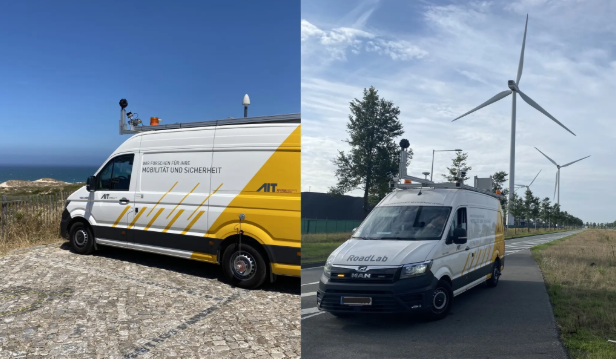
The CAMBER project continues to make progress across its European pilot sites, with the successful completion of two data collection campaigns in North Holland (the Netherlands) and Cascais (Portugal). Led by AIT – Austrian Institute of Technology, these activities gathered high-precision road data to support the development of innovative, data-driven solutions for safer and more efficient road infrastructure management.
In Cascais, assessments were undertaken across 75 km of road stretches across both urban and interurban environment, and in North Holland measurements were gathered across 10 road sections totalling approximately 50 km.
Both campaigns combined AIT’s RoadLab mobile laboratory with a sensor-equipped motorcycle probe vehicle to collect complementary datasets. The advanced measurement systems captured high-precision reference data on road geometry, slope, transverse and longitudinal evenness, and surface condition. The motorcycle also recorded dynamic driving data, including trajectories and acceleration, providing additional insights into road conditions and vehicle behaviour.
The collected data will serve three main purposes within CAMBER:
- Validating new-generation data collected across the pilot sites by providing reliable ground-truth references.
- Supporting Digital Twin development through accurate, high-precision information on road infrastructure.
- Contributing to iRAP Star Rating assessments, helping evaluate road safety performance using the methodology applied within the project.
In North Holland, these activities represent an important step forward for the pilot, led by SWOV in collaboration with local and technical partners. The pilot will explore how data from multiple sources can help identify safety hotspots on roads and cycling infrastructure, with particular attention to road curves, primary cycle routes, cycle crossings and school zones.
Together, the two campaigns strengthen CAMBER’s evidence base for integrated road asset and safety management, helping transform detailed road measurements into actionable insights for safer, smarter and more resilient road networks across Europe.
Crowdsourced data for safer cycling: CAMBER research at ICTCT 2026
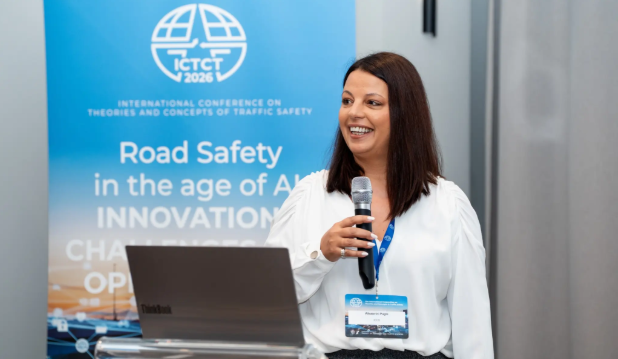
The 38th International Co-operation on Theories and Concepts in Traffic Safety (ICTCT) Conference took place on 22-23 October in Zagreb, Croatia, bringing together researchers, practitioners and policymakers working in the field of road traffic safety.
The conference provided a multidisciplinary forum for exchanging theories, concepts, methodologies and research findings, with a strong focus on human behaviour, crash causation and the evaluation of road safety measures.
Katia Pagle from I-SENSE Group/ICCS,who leads CAMBER’s WP5 on Pilot Testing and Evaluation and the Trikala pilot, presented the research paper “Crowdsourced Pavement Intelligence for Safer Urban Cycling Infrastructure: Platform Development and Pre-Pilot Evaluation within the CAMBER Project”.
The paper introduces an innovative platform being developed within the CAMBER pilot in Trikala, to support safer cycling infrastructure through crowdsourced data and Artificial Intelligence.
The platform enables cyclists to record their everyday rides using a mobile app, while an AI model automatically detects pavement defects, such as cracks and potholes, from the recorded videos and maps their locations. Municipal operators can then review the detected issues through a web-based dashboard, while the processed data are made openly available through Zenodo.
By providing cities with continuous, low-cost information on the condition of their cycling networks, the platform aims to complement periodic infrastructure inspections, helping identify and address potential safety issues before they affect road users.
Stakeholder workshops for Greek Pilot in Trikala
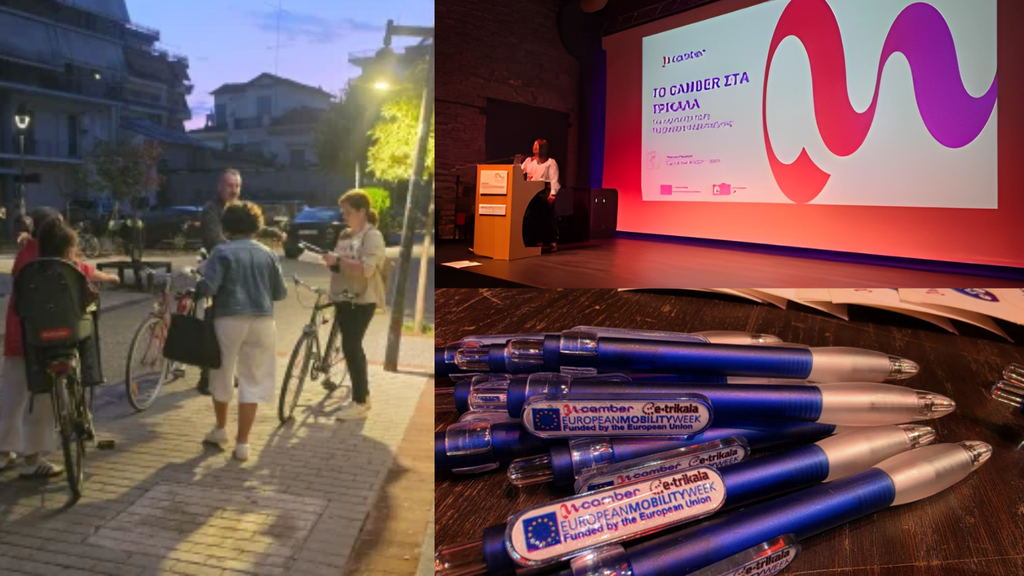
CAMBER has been undertaking stakeholder engagement activities in Trikala with the successful organisation of the second of three planned stakeholder workshops for the Greek pilot held on 22 September as part of European Mobility Week 2026.
The workshop marked another important milestone in establishing a local Community of Practice and was co-organised by ISENSE Group (which leads the Trikala pilot) and e-Trikala.
The workshop opened with a welcome speech by Vasilena Mitsiadi (e-Trikala), followed by an introduction to the CAMBER project by Katia Pagle (ICCS). Pinelopi Alexiou (ICCS) then led an interactive activity focused on understanding and improving public space through quality indicators.
Following a briefing on how to observe the road environment and use the CAMBER app, participants took part in an exploratory cycling activity through the city, putting these tools into practice while experiencing the local road environment firsthand. The activity was followed by a short break and mini-interviews, providing an opportunity to gather participants’ observations and feedback.
The workshop concluded with a presentation of the CAMBER data dashboard, demonstrating how the information collected is visualised and managed. Vangelis Tsougiannis (ICCS) led a hands-on training session on using the dashboard and managing data, before George Vallas (e-Trikala) delivered the closing remarks.
The feedback and observations collected during the workshop will contribute to validating CAMBER’s innovative approach to integrating road asset and safety management, helping ensure that the solutions developed reflect the needs and experiences of local road users.
Innovative digital twin solutions for enhanced road asset and safety management
How can Digital Twins and data from multiple sensing technologies help make road safety and maintenance more proactive? This question was at the centre of an online workshop that took place on September 23, bringing together the EU-funded CAMBER, EvoRoads and iDriving projects to explore how digital technologies can support safer, more data-driven road infrastructure management.
Across the three presentations, the projects showcased different approaches to collecting, integrating and analysing road data, while demonstrating how digital environments can support the testing and implementation of safety and maintenance interventions.
Thomas Bapaume (Gustave Eiffel University) presented iDriving‘s approach to building realistic Digital Twin models with limited and heterogeneous data. Its work combines heterogeneous sources—including UAVs, cameras and traffic data—and detection results are used as simulation parameters to estimate dangerous road-user behaviours, road-user characteristics and road conditions, allowing safety indicators to be evaluated under different simulated scenarios. The resulting insights can support a range of applications, from providing information and alerts to road users to supporting traffic management, city planners and road authorities. Looking ahead, the project is extending its Digital Twin with a maintenance component, additional road-user behaviours and scenarios, and CARLA for 3D traffic representation and incident reconstruction.
Federico Pinciotto (Fondazione Links) presented EvoRoads’ Smart Mobility Digital Twin, designed as a single access point for data from the project’s pilot sites and technical partners. Using a common data model, the platform integrates heterogeneous data sources and supports both real-time data exchange and historical analysis. In the Italian pilot in Turin and the Piedmont region, the Digital Twin is being used across three scenarios, including vehicle–pedestrian interactions, road surface condition monitoring, and pedestrian behaviour at signalised intersections. Data from cameras, LiDAR and mobile sensing units are used to generate safety and maintenance insights, supporting interventions such as variable message signs and road maintenance planning.
Bernard Kosovec (Faculty of Transport and Traffic Sciences – University of Zagreb) presented CAMBER‘s approach to testing low-cost road safety interventions through simulation before their implementation in real-world conditions. The project focuses on improving safety on urban and secondary rural roads, with the driving simulator study examining different treatments for hazardous rural curves. By combining driving behaviour, eye-tracking data and participant feedback, the study evaluated how different road markings and surface treatments influence speed, lateral positioning and driver attention. The findings are now being taken into the field through a real-world evaluation of an anti-skid surface, illustrating how simulation can support the selection and validation of safety interventions before wider implementation.
Together, the presentations demonstrate how Digital Twins can connect data, simulation and real-world road management, supporting more informed decisions on safety and maintenance.
Watch the full webinar recording and explore the approaches, pilot activities and methodologies presented by the three projects here.
Stakeholders help shape next steps for Croatian Pilot
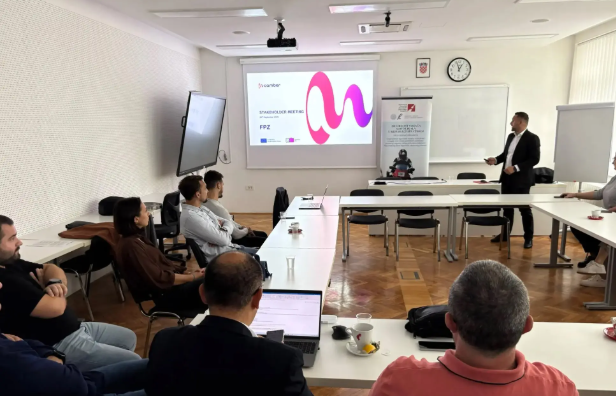
On 24 September, CAMBER held its third stakeholder meeting of the Croatian pilot in Zagreb, bringing together representatives from the road sector to discuss the progress of the project, ongoing activities within the Croatian pilot and challenges related to road infrastructure management and safety.
The meeting gathered stakeholders with different roles and perspectives within the road sector, including representatives of road authorities, road designers and engineers, as well as professionals working in road management, maintenance and safety. Their participation provided an opportunity to connect the project’s research and technical activities with practical experience and the everyday needs of those responsible for planning, managing and improving road infrastructure.
The meeting opened with an overview of the CAMBER project, its current status and key developments, followed by a closer look at the project objectives and expected contribution of the Croatian pilot. Participants were also updated on progress within Work Package 5 (Pilot testing and evaluation), including the implementation status across pilot locations in Croatia.
The project team then presented the selected pilot locations in greater detail, together with the issues identified through the project activities and the measures planned or already implemented to address them. This provided a basis for an interactive discussion on the approaches being explored, lessons learned and considerations for the next stages of implementation. Stakeholders shared their perspectives and feedback, providing valuable input from professionals directly involved in different stages of road planning, design, management and maintenance.
An important aspect of the stakeholder engagement process has been the continuity of participation, with several stakeholders attending all three meetings held in Croatia so far. This ongoing involvement has allowed participants to follow the pilot’s progress over time, review new developments and results and provide feedback throughout the implementation process.
By maintaining this continuous exchange between the project team and road practitioners, CAMBER is helping ensure that the Croatian pilot remains closely connected to real-world needs and practical experience as it moves forward.
About the CAMBER Methodology and Consortium
There is no single ‘silver bullet’ or one-size-fits-all solution which can address the safety and maintenance challenges facing road managers. For this reason, the CAMBER project will focus on five priority ‘components’ which the project team will advance through research and innovation to meet the stated project objectives. The components are:
- Safety-integrated maintenance systems and processes
- New-generation data sources
- Digital twins
- ADAS performance
- Low-cost safety interventions
Project partners include ERTICO, EIRA, iRAP, SWOV Institute for Road Safety Research, Laboratorio Nacional de Engenharia Civil, iSENSE Group, BEMOBILE, FPZ, UHASSELT, Vicomtech, Agilysis, Austrian Institute of Technology (AIT), e-Trikala, Ministerio de Transportes y Movilidad Sostenible, and Red de Carreteras del Estado.
Images credit: Header image Roman Babakin; Others CAMBER