
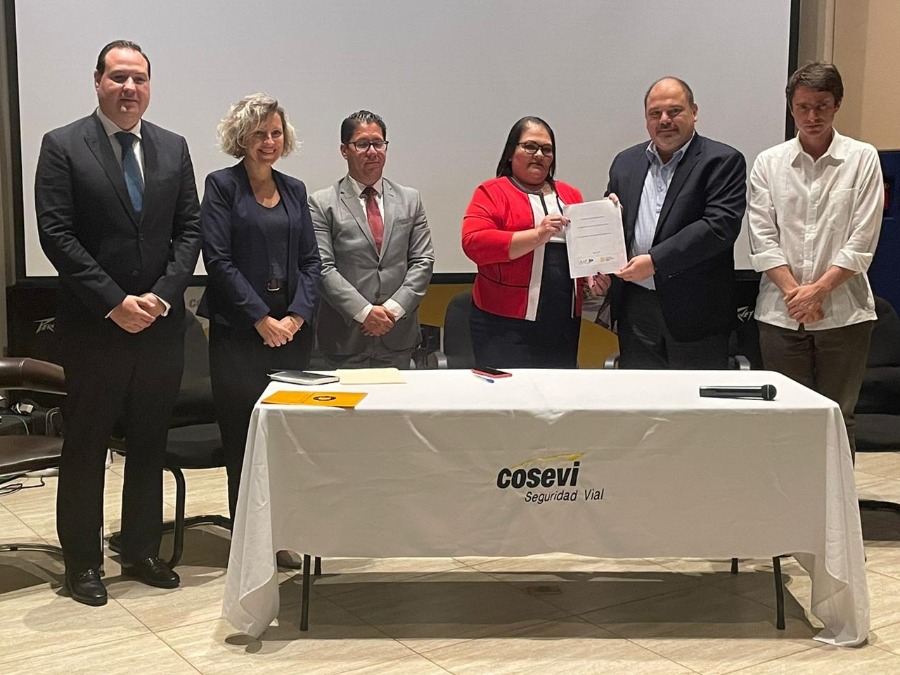
Le Conseil de sécurité routière du Costa Rica (COSEVI) et International Road Assessment Programme (iRAP) sont fiers d'annoncer la signature aujourd'hui d'un protocole d'entente (PE) visant à promouvoir des programmes et des projets pour éliminer les routes à haut risque au Costa Rica.
Selon Explorateur des informations de sécurité de iRAP, Au Costa Rica, plus de 810 personnes meurent et 22 330 sont grièvement blessées chaque année dans des accidents de la route, pour un coût estimé entre 1 090 et 2,3 milliards de dollars américains. Parmi ces victimes, on estime que 242 souffrent de lésions médullaires, dont certaines entraînent une paralysie, 2 750 de traumatismes crâniens et 55 d'amputations.
Le Costa Rica s'est engagé à réduire le nombre de décès et de blessures causés par les accidents de la route, ainsi qu'à développer des infrastructures et des systèmes de transport sûrs et accessibles, en accordant une attention particulière aux besoins des usagers vulnérables de la route.
Ce partenariat sera axé sur la promotion de transports sûrs et durables, l'application de la méthodologie et des outils iRAP, et le renforcement des capacités pour des routes plus sûres, conformément à l'objectif de la deuxième Décennie d'action pour la sécurité routière visant à réduire de moitié le nombre de décès sur les routes d'ici à 2030 et aux objectifs de performance 3 et 4 des Nations Unies en matière de sécurité routière. Ces objectifs comprennent la garantie que toutes les nouvelles routes soient construites selon une norme de 3 étoiles ou supérieure pour tous les usagers de la route (objectif 3), et que plus de 751 TP8 T de déplacements s'effectuent sur des routes équivalentes à 3 étoiles ou supérieures pour tous les usagers de la route d'ici à 2030 (objectif 4).
Cette coopération conjointe de deux ans comprendra le renforcement des capacités institutionnelles pour les évaluations iRAP des routes costariciennes et l'élaboration de plans d'investissement pour des routes plus sûres afin d'orienter les investissements stratégiques visant à éliminer les tronçons de route à haut risque.
L’amélioration des systèmes et des bases de données de l’Observatoire de la sécurité routière grâce à l’utilisation d’informations géoréférencées sur la sécurité routière sera une priorité, de même que l’accent mis sur la collaboration avec les partenaires de la sécurité routière dans la région afin d’exploiter l’énorme potentiel d’une approche multisectorielle pour améliorer la sécurité.
Les deux organisations élaboreront des plans de communication et des outils de sensibilisation afin de mieux faire connaître au public la norme de sécurité routière 3 étoiles ou supérieure et les avantages socio-économiques de routes sûres.
M. Roy Rojas, directeur de projet chez COSEVI, a salué la signature du protocole d'entente en déclarant : “ COSEVI intègre iRAP à ses efforts globaux pour sauver des vies au Costa Rica. Nous sommes convaincus que la méthodologie iRAP sera un outil précieux pour expliquer les facteurs de risque liés aux infrastructures du pays. Le Costa Rica remercie iRAP de lui offrir l'opportunité de se joindre aux efforts de COSEVI pour sauver des vies. ”
Edgar Zamora, responsable régional pour les Amériques du programme iRAP Safer Journeys, présent lors de la signature du protocole d'entente, a déclaré : “ iRAP est fier de s'associer à COSEVI pour améliorer la sécurité routière au Costa Rica. L'élimination des routes à haut risque est essentielle pour sauver des vies, en particulier celles des usagers vulnérables, et pour réduire le fardeau économique et social évitable des accidents de la route. ”
L’activité iRAP, menée par des partenaires, a déjà permis d’évaluer 4 383 km de routes et leurs aménagements au Costa Rica, ainsi que 10 écoles, contribuant ainsi à l’amélioration de la sécurité routière grâce à un investissement de 388 millions de dollars ($) dans les infrastructures routières. Le Costa Rica a participé à une vaste évaluation de la sécurité routière du corridor Pacifique, menée dans sept pays par la Banque interaméricaine de développement en 2011 et en 2020, qui a permis d’orienter des investissements essentiels pour améliorer la sécurité routière.
“ Ce partenariat continuera de s’appuyer sur ces efforts et collaborations stratégiques pour améliorer la sécurité routière dans le pays et soutenir la mise en œuvre de Plan mondial de la Décennie d’action pour la sécurité routière 2021-2030,” », a déclaré M. Zamora.
Le protocole d'entente a été signé pendant la Promouvoir une mobilité urbaine sûre et durable en Amérique latine Événement du Costa Rica et du Mexique, organisé par le COSEVI, avec la participation de l'Institut pour les politiques de transport et de développement (ITDP), de FIA Foundationa et de l'Automobile Club du Costa Rica.
Réaliser plus de 75 % des déplacements sur des routes 3 étoiles ou mieux au Costa Rica d'ici 2030 permettrait d'éviter près de 60 000 décès et blessures graves sur la durée de vie de 20 ans des travaux routiers, avec un avantage économique de 1 TP9T11,2 milliards de dollars américains, soit près de 1 TP9T9 pour chaque 1 TP9T1 dépensé.
– FIN –
À propos du COSEVI
Le Conseil costaricien de sécurité routière (COSEVI) élabore des politiques, facilite, supervise et intègre les efforts par le biais du financement de projets de sécurité routière, exécutés de manière interorganisationnelle et visant à créer, promouvoir et maintenir une culture de la sécurité routière dans la société, contribuant ainsi à améliorer les conditions et la qualité de vie des habitants du Costa Rica.
https://www.csv.go.cr/
À propos du Programme international d'évaluation des routes (iRAP)
iRAP est une organisation caritative enregistrée qui œuvre pour un monde sans routes dangereuses. Présente dans plus de 100 pays, elle collabore avec les gouvernements, les banques de développement, les clubs de mobilité, les organismes de recherche et les ONG de sécurité routière afin de leur fournir gratuitement les outils, les systèmes et les formations nécessaires pour améliorer la sécurité routière. La méthodologie d'évaluation par étoiles de iRAP offre une mesure simple et objective du niveau de sécurité intrinsèque de la route pour les automobilistes, les motocyclistes, les cyclistes et les piétons. Une route à 1 étoile est la moins sûre, tandis qu'une route à 5 étoiles est la plus sûre. L'organisation a contribué à améliorer la sécurité de plus de 19 000 milliards de dollars d'investissements dans les infrastructures, a évalué la sécurité de plus de 1,3 million de kilomètres de routes, cartographié les risques sur plus de 1,6 million de kilomètres et formé plus de 54 000 personnes à travers le monde. iRAP est le programme-cadre des programmes régionaux d'évaluation des routes, notamment EuroRAP, ChinaRAP, AusRAP, usRAP, KiwiRAP, IndiaRAP, BrazilRAP, South Africa RAP, ThaiRAP et MyRAP, et est soutenu financièrement par FIA Foundation et le Fonds mondial pour la sécurité routière.
https://irap.org/
Pour plus d'informations :
International Road Assessment Programme (iRAP)
Edgar Zamora, responsable du programme « Voyages plus sûrs » pour l’Amérique latine (iRAP)
E-mail: edgar.zamora@irap.org
Téléphone portable : +506 8365-8643
Conseil costaricien de sécurité routière (COSEVI)
Roy Rojas, directeur de projet
Courriel : rrojas@csv.go.cr
Téléphone portable : +506 2522-0900