
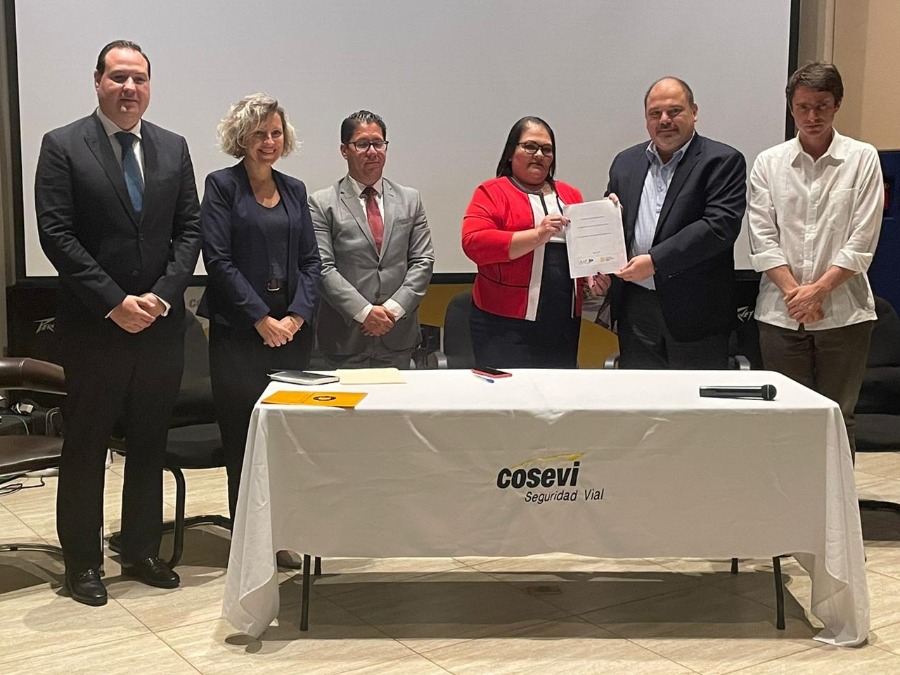
The Road Safety Council of Costa Rica (COSEVI) et International Road Assessment Programme (iRAP) are proud to announce the signing today of a Memorandum of Understanding (MOU) to promote programmes and projects to eliminate high-risk roads in Costa Rica.
Selon Explorateur des informations de sécurité de iRAP, more than 810 people are killed and 22,330 people are seriously injured each year due to road crashes in Costa Rica at a cost of USD$2.3 billion. Of these, it is estimated that 242 people suffer spinal injuries including paralysis, 2,750 people incur brain injuries and 55 lose limbs.
Costa Rica is committed to reducing deaths and injuries caused by road traffic crashes, as well as the development of safe and accessible transport infrastructure and systems, paying special attention to the needs of vulnerable road users.
The partnership will focus on the promotion of safe and sustainable transport, application of the iRAP methodology and tools, and capacity building for safer roads aligned to the Second Decade of Action for Road Safety goal to halve road deaths by 2030 and UN Global Road Safety Performance Targets 3 and 4. The Targets include ensuring all new roads are built to a 3-star or better standard for all road users (Target 3), and more than 75% of travel is on the equivalent of 3-star or better roads for all road users by 2030 (Target 4).
The two-year joint cooperation will include institutional capacity building for iRAP assessments of Costa Rican roads and development of Safer Road Investment Plans to inform strategic investment to eliminate high-risk road sections.
Improvement of the Road Safety Observatory’s systems and databases through the use of geo-referenced information on road safety will be a focus, as well as an emphasis on collaboration with road safety partners in the region to harness the enormous potential of a multi-sector approach to improving safety.
Both organisations will develop communications plans and outreach materials to raise public awareness of the 3 star or better road safety standard and the social and economic benefits of safe roads.
Mr Roy Rojas, COSEVI Project Director celebrated the signing of the MOU saying: “COSEVI adds iRAP as one more component of our comprehensive efforts to save lives in Costa Rica. We believe that the iRAP methodology will be a highly valuable tool to explain risk factors associated with the country’s infrastructure. Costa Rica thanks iRAP for the opportunity to join COSEVI’s effort to save lives.”
iRAP Safer Journeys Regional Leader for the Americas, Edgar Zamora, who was present at the MOU signing said, “iRAP is proud to partner with COSEVI to improve road safety in Costa Rica. Eliminating high-risk roads is critical to saving lives, particularly of vulnerable road users, and reducing the preventable economic and social burden caused by road crashes.”
Partner-led iRAP activity has already assessed 4,383 km of roads and designs in the country, and 10 schools influencing the safety of US$388 million of road infrastructure investment. Costa Rica was part of a large Pacific Corridor road safety assessment across 7 countries performed by the Inter-American Development Bank in 2011 and again in 2020 informing life-saving investment in safer road upgrades.
“The partnership will continue to build on these efforts and strategic collaborations to improve road safety in the country and support implementation of the Plan mondial de la Décennie d’action pour la sécurité routière 2021-2030,” Mr Zamora said.
Le protocole d'entente a été signé pendant la Promoting Safe and Sustainable Urban Mobility in Latin America event of Costa Rica and Mexico, hosted by COSEVI, with participation of the Institute for Transportation and Development Policy (ITDP), FIA Foundationa and the Automobile Club of Costa Rica.
Achieving greater than 75 per cent of travel on 3-star or better roads in Costa Rica by 2030, stands to save nearly 60,000 fatalities and serious injuries over the 20 year life of road treatments with an economic benefit of USD$11.2 billion, nearly $9 for every $1 spent.
– FIN –
About COSEVI
The Costa Rican Road Safety Council (COSEVI) formulates policies, facilitates, oversees and integrates efforts through the financing of road safety projects, executed inter-organisationally and aimed at creating, promoting and maintaining a culture of road safety in society, thereby contributing to achieving a better condition and quality of life for the people of Costa Rica.
https://www.csv.go.cr/
À propos du Programme international d'évaluation des routes (iRAP)
iRAP est une organisation caritative enregistrée qui œuvre pour un monde sans routes dangereuses. Présente dans plus de 100 pays, elle collabore avec les gouvernements, les banques de développement, les clubs de mobilité, les organismes de recherche et les ONG de sécurité routière afin de leur fournir gratuitement les outils, les systèmes et les formations nécessaires pour améliorer la sécurité routière. La méthodologie d'évaluation par étoiles de iRAP offre une mesure simple et objective du niveau de sécurité intrinsèque de la route pour les automobilistes, les motocyclistes, les cyclistes et les piétons. Une route à 1 étoile est la moins sûre, tandis qu'une route à 5 étoiles est la plus sûre. L'organisation a contribué à améliorer la sécurité de plus de 19 000 milliards de dollars d'investissements dans les infrastructures, a évalué la sécurité de plus de 1,3 million de kilomètres de routes, cartographié les risques sur plus de 1,6 million de kilomètres et formé plus de 54 000 personnes à travers le monde. iRAP est le programme-cadre des programmes régionaux d'évaluation des routes, notamment EuroRAP, ChinaRAP, AusRAP, usRAP, KiwiRAP, IndiaRAP, BrazilRAP, South Africa RAP, ThaiRAP et MyRAP, et est soutenu financièrement par FIA Foundation et le Fonds mondial pour la sécurité routière.
https://irap.org/
Pour plus d'informations :
International Road Assessment Programme (iRAP)
Edgar Zamora, iRAP Safer Journeys Lead for Latin America
E-mail: edgar.zamora@irap.org
Mobile: +506 8365-8643
Costa Rican Road Safety Council (COSEVI)
Roy Rojas, Project Director
Email: rrojas@csv.go.cr
Mobile: +506 2522-0900