
Many transport projects already use simulation tools to assess traffic operations, congestion, travel times, and network performance. However, safety outcomes are often assessed independently of the traffic model, commonly through iRAP´s Star Ratings. The Star Ratings rely on road attributes, traffic volumes, and operating speeds collected through field surveys and road inspections, rather than being derived from traffic simulations, and are often performed only after designs have been finalised. The integration between Aimsun Next and iRAP’s ViDA platform creates an opportunity to bring road safety assessment directly into the simulation process, enabling practitioners to evaluate both operational and safety performance within the same modelling framework.
Developed and demonstrated through the PHOEBE project, the connectivity framework links simulation outputs from Aimsun Next with the iRAP Star Rating methodology managed through ViDA. Traffic variables such as speed, traffic flow, and other operational indicators can be transferred and transformed into inputs for the Star Rating model, allowing a wide range of scenarios, not limited to physical infrastructure changes, to be assessed from a road safety perspective.
Why Should Suppliers and Project Teams Consider This Integration?
If your organisation is already undertaking traffic simulation studies, the data needed for safety analysis on future scenarios are already being generated. By connecting simulation outputs with ViDA, projects can gain additional insights without needing to develop an entirely separate assessment process.
The integration enables project teams to:
- Assess the potential safety implications of proposed interventions before implementation.
- Compare alternative scenarios using both operational and safety indicators
- Visualise changes in Star Ratings under different traffic and infrastructure conditions.
- Support evidence-based investment decisions using internationally recognised safety metrics.
- Create a common language between traffic engineers, planners, and road safety professionals.
Visualising Star Ratings Within Simulation Scenarios
The connectivity framework enables simulation outputs generated in Aimsun Next, such as traffic flow, average speed, and speed variability, to be transformed into inputs for the iRAP Star Rating methodology within ViDA. This allows changes in operational conditions to directly influence safety assessments, creating a stronger connection between transport planning and evidence-based road safety evaluation.
The process relies on three key components:
- Network compatibility between Aimsun Next and ViDA through GIS-based matching of road elements. Tutorial available here.
- Data harmonisation to convert simulation outputs into formats compatible with the Star Rating model. API available on demand.
- Data exchange routines that transfer information between platforms and enable recalculation of safety outcomes for different scenarios. API available on demand.
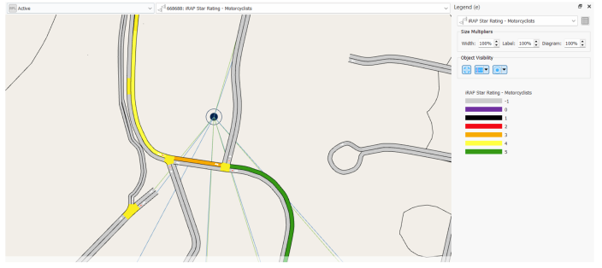
One of the most exciting opportunities created by this integration is the ability to visualise Star Rating results inside the Aimsun Next simulation environment. The integration follows a simple workflow. First, the road network and Star Rating data are imported from ViDA and aligned with the corresponding Aimsun Next network through a network compatibility process. Traffic simulations are then run in Aimsun Next for specific scenarios, generating outputs such as traffic flows, speeds, and speed variability. These outputs are transformed into a format compatible with the iRAP Star Rating model and transferred to ViDA, where Star Ratings and risk scores are recalculated.
The updated safety results can then be returned to the traffic simulator and displayed alongside traditional simulation outputs, allowing users to visualise how safety performance changes under different infrastructure, traffic management, or mobility scenarios.
An Opportunity for Ongoing Projects
For organisations currently undertaking simulation studies, this integration provides an opportunity to extend the value of existing modelling work. iRAP Star Ratings give organisations a consistent, internationally recognised way to assess road safety, that can provide also insight on the dynamic risk through the replacement of static snapshot with a dynamic view brought by the traffic simulation. And goes beyond. Safety assessment can now incorporate interventions in in specific scenarios, different demand levels, driver behaviours, or policy changes, to reveal how speeds and interactions actually vary across the network, and giving authorities insight into those safety effects early, so they can adjust decisions before implementation rather than reacting later to issues that emerge.
Whether the objective is to support Safe System implementation, evaluate active mobility investments, or demonstrate the benefits of infrastructure upgrades, linking simulation outputs with ViDA can help quantify and communicate safety outcomes in a consistent and internationally recognised way.
As the framework progresses towards greater automation, the vision is to make the exchange of information between Aimsun Next and ViDA increasingly efficient, supporting repeatable and scalable safety assessments across cities, regions, and transport projects.
For iRAP suppliers, consultants, researchers, and project teams already investing in simulation modelling, this represents an opportunity to add a powerful safety dimension to existing workflows and demonstrate not only how a transport intervention will operate, but also how it can contribute to safer roads for all users.