
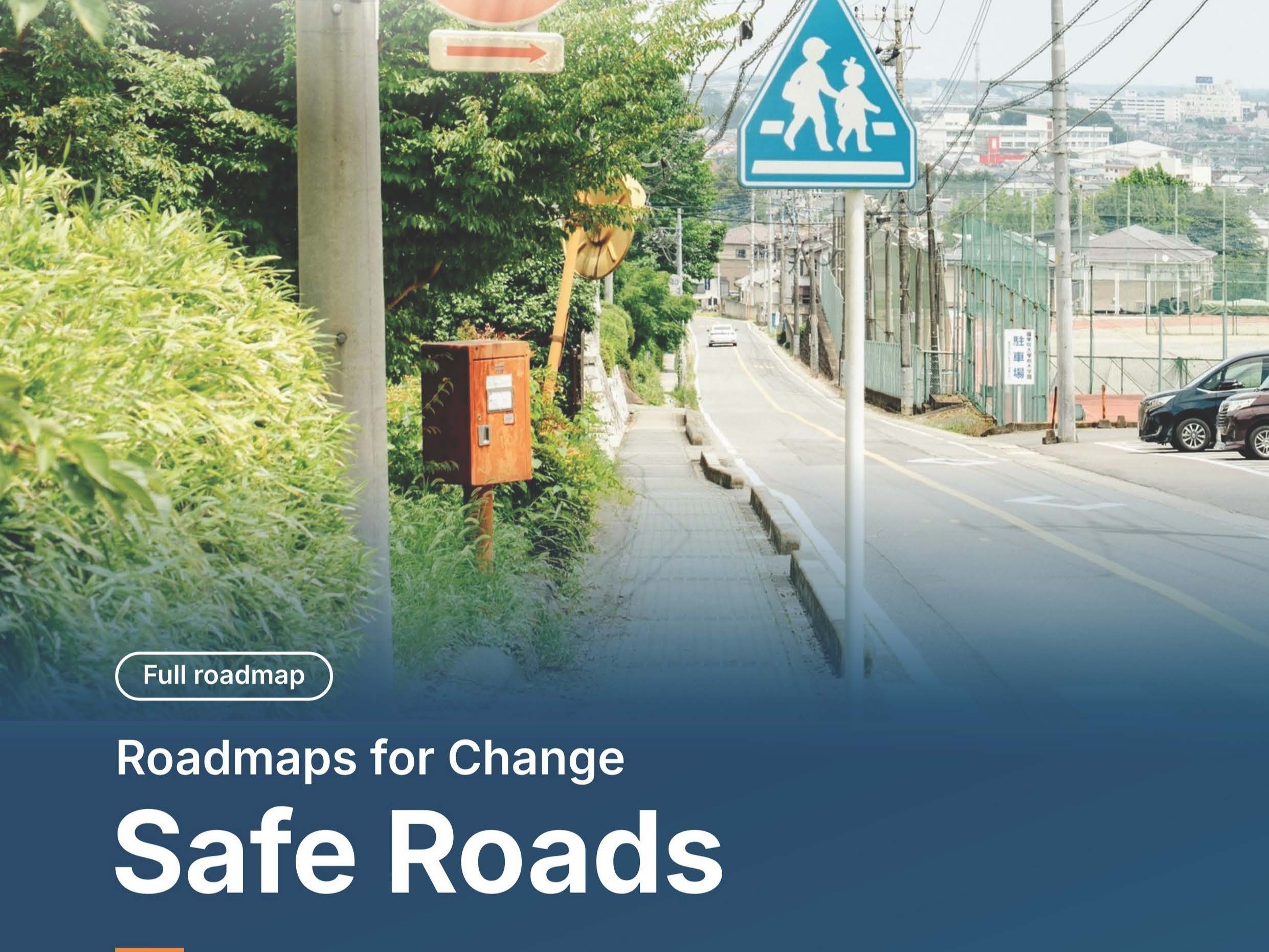
iRAP is proud to join the International Road Federation (IRF) and a global coalition of partners launching Roadmaps for Change in Geneva today; four practical guides for the UN Decade of Sustainable Transport that show road agencies what inclusive, safe, green and efficient roads look like by 2035 and how to get there. iRAP has led on the Safe Roads Roadmap.
How roads are planned, designed, built, operated and maintained over the next ten years will decide much of what the UN Decade of Sustainable Transport (2026–2035) can achieve. Whether a rural clinic can be reached in the rainy season, whether a child can walk safely to school, whether a road stays open after a flood and whether a corridor keeps goods moving through disruption depend heavily on decisions taken every day by road agencies and authorities.
The UN Decade of Sustainable Transport, launched in December 2025, sets six priority action areas, from access for all and low-carbon, resilient transport to safety, efficiency and innovation. As the backbone of most transport systems, roads are central to each of these ambitions. The scale of the task is clear across all four themes the roadmaps cover.
The Safe Roads Roadmap: For roads that protect every life
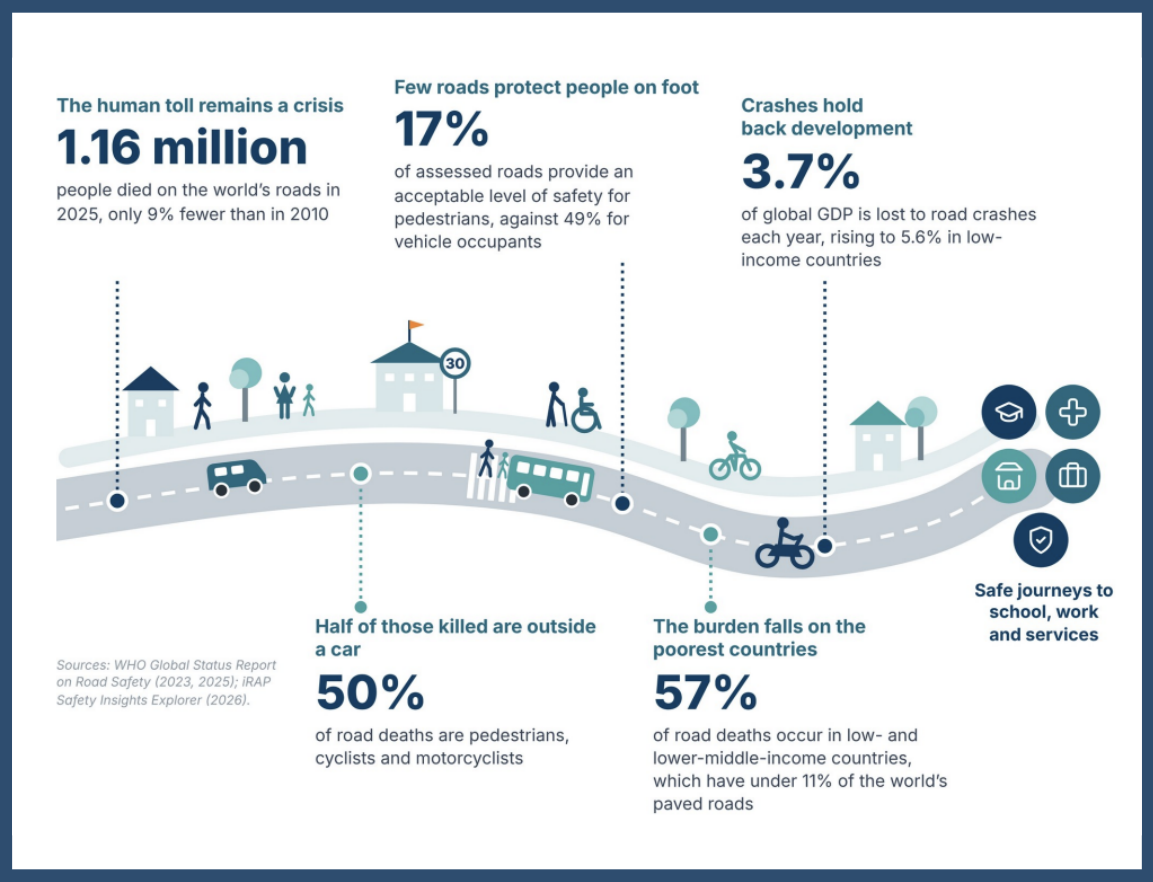
Road crashes cost an estimated USD 3.6 trillion a year, more than 3% of global GDP. Half of all people killed on the roads are walking, cycling or riding a motorcycle. Safe Roads applies the Safe System approach so that new roads are planned, designed, operated and maintained to achieve safe performance for all road users. The roadmap shows agencies how to identify high-risk roads, prioritise investment using evidence and systematically eliminate infrastructure-related crash risks through safer designs, upgrades and speed management.
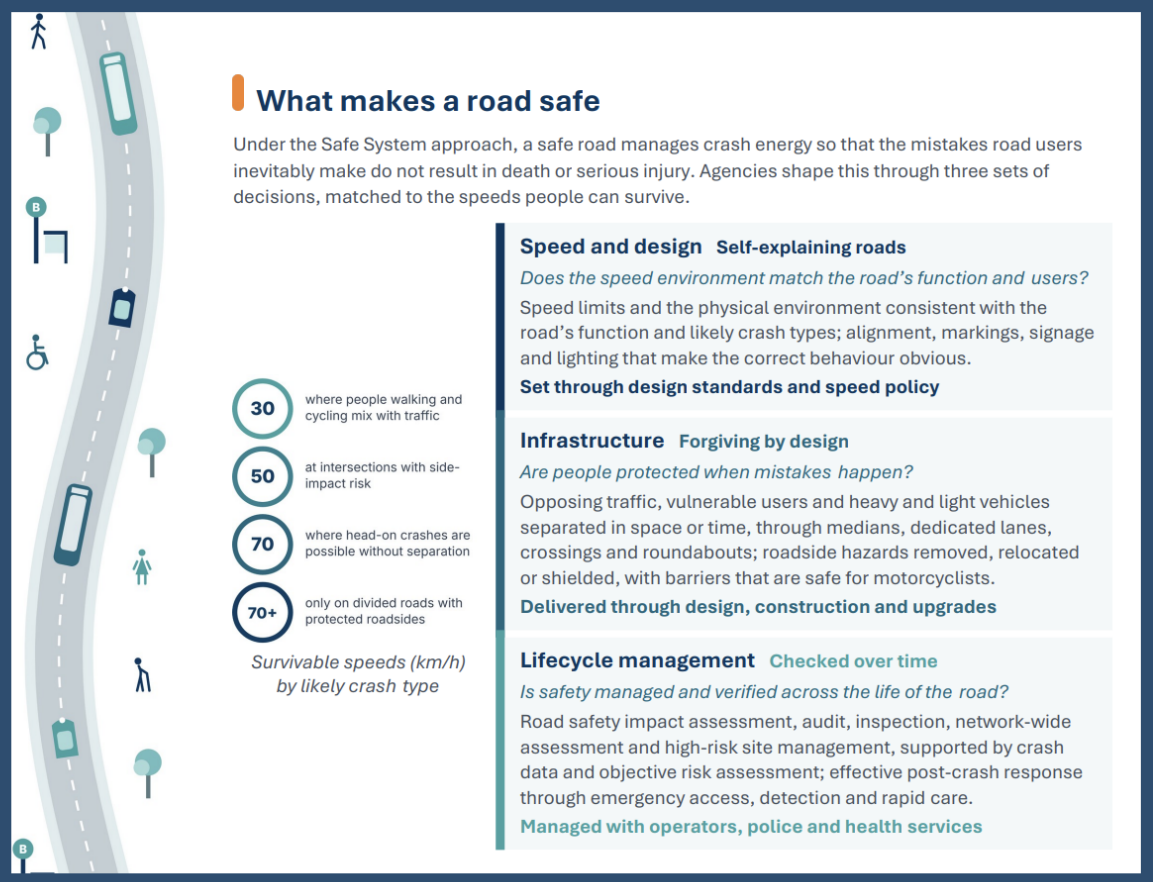
“The UN Decade is part of a once-in-a-generation opportunity to eliminate high-risk roads. Ensuring that roads achieve at least 3-star safety standards for all users provides governments with a measurable pathway to save lives at scale. The Roadmaps for Change bring together practical guidance and proven tools to help agencies direct investment where it will have the greatest impact and accelerate progress toward safer, more sustainable transport systems.”
Greg Smith, CEO, International Road Assessment Programme (iRAP)
More about the Road Maps for Change Series
The Roadmaps for Change Series was launched today during the 2026 International Road Federation (IRF) Annual Conference being held from 16-18 November in Geneva.
The four Roadmaps cover Safe Roads, Inclusive Roads, Green Roads and Efficient Roads.
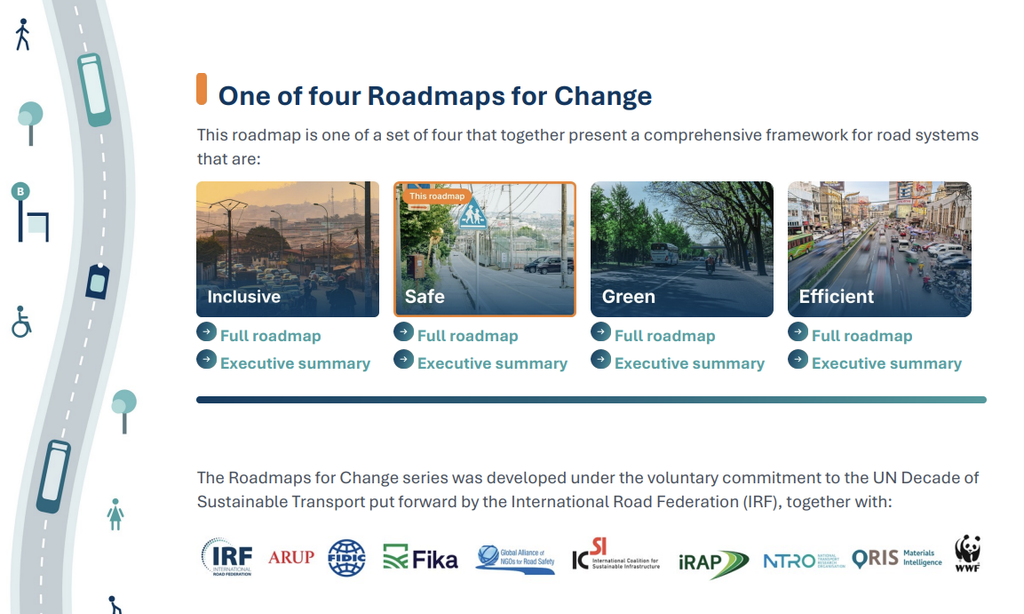
Their production form part of a voluntary commitment under the UN Decade, put forward by IRF and its partners: iRAP, Arup, the Australian National Transport Research Organisation, FIKA, the Global Alliance of NGOs for Road Safety, the International Coalition for Sustainable Infrastructure, the International Federation of Consulting Engineers, ORIS Materials Intelligence and World Wildlife Fund-US.
In addition to the Roadmap for Safe Roads:
The Inclusive Roads Roadmap: For roads that serve everyone and get more from every kilometre
Low-income countries hold only 1.5% of the world’s roads and around 700 million rural residents still live more than 2 km from an all-season road. In Sub-Saharan Africa, this affects more than a third of the rural population. Access is a challenge in cities too, where many people cannot safely walk, cycle or reach public transport. For many communities, rural and urban, these gaps turn every trip to a clinic, school, job or market into a longer, costlier and less safe journey. Inclusive Roads sets out how road networks can let all people, regardless of age, gender, ability, income or mode of travel, reach these services all year round, safely, affordably and with dignity. It looks beyond the road itself, so that people can complete whole journeys across the wider transport system, from footways and crossings to bus stops and interchanges.
“The Inclusive Roads roadmap provides road agencies with practical guidance to plan, prioritise and invest in transport infrastructure that improves access to social and economic opportunities. It encourages a more comprehensive understanding of how entire transport networks, including rural paths, crossings and feeder roads, connect first-mile communities. Fika contributed to the roadmap to reinforce the importance of rural connectivity in inclusive infrastructure planning and to demonstrate how evidence-based investments can extend the benefits of road networks to communities that would otherwise remain isolated.”
Nivi Sharma, CEO, Fika
The Efficient Roads Roadmap: Roads That Get More From Every Kilometre
Where road networks do exist, many work far below their potential. In 2025, drivers lost 195 hours to rush-hour traffic in Lima, 184 in Mexico City and 168 in Bengaluru. Efficient Roads describes networks that operate as synchronised, data-driven systems, are planned around people throughput and safe multimodal integration and are managed through predictive maintenance that gets the most value from existing assets.
“Roads are where the ambitions of the UN Decade meet daily life. Making our networks work for everyone and getting the most from every kilometre we already have are the fastest ways to deliver on the Decade. Roadmaps for Change gives road agencies practical direction they can act on within their own mandates and budgets.”
Dimitrios Mandalozis, President, International Road Federation
The Green Roads Roadmap: Roads that cut emissions, withstand climate shocks, use materials efficiently and give back to nature
Building and maintaining the world’s road and rail infrastructure emits about 358 million tonnes of CO₂e a year from materials alone, roughly 1% of global greenhouse gas emissions. Natural hazards also cause USD 3.1–22 billion of direct damage to road and rail assets each year. Green Roads sets out how road infrastructure can contribute to national decarbonisation goals, keep providing services amid disruptions, use materials efficiently and avoid harm to nature while helping to restore it.
“ORIS is proud to co-author this work with practical recommendations and actionable pathways for public agencies, in line with the goals set by the UN Decade of Sustainable Transport. These roadmaps resonate with our company mission towards sustainable infrastructure and will definitely help authorities make road networks more efficient, low-carbon, accessible to more people, while respectful of nature and resources.” Nicolas Miravalls, CEO, ORIS Materials Intelligence
“The coming decades will see a massive surge in road construction. The Green Roads roadmap demonstrates that economic development and conservation can go hand in hand. By considering biodiversity from the outset, road agencies can deliver infrastructure that is resilient, cost-effective, and supportive for both people and nature.”
Nik Sekhran, Chief Conservation Officer, World Wildlife Fund
Built by the sector, for the sector
More than 90 authors, contributors and peer reviewers from road agencies and ministries, multilateral development banks, universities, industry and civil society across Africa, Asia, Europe, Oceania and the Americas shaped the Roadmaps guidance.
Each roadmap follows the questions agency leaders and technical teams ask, from why the theme matters to their mandate to which decisions they can influence at each stage of the road lifecycle. Each ends with a self-assessment checklist so that every team can begin from its own starting point.
“The success of these roadmaps will ultimately depend on how they influence decisions on the ground. Making roads safer, greener, more inclusive and efficient means embedding these priorities into how infrastructure is planned, designed, procured and delivered. Consulting engineers have a central role in making that happen, and FIDIC looks forward to working with IRF and its partners to support implementation throughout the UN Decade.”
Susanna Zammataro, CEO, International Federation of Consulting Engineers (FIDIC)
The road ahead starts now
The roadmaps are living documents and the starting point for a programme of work that runs through the Decade. From 2027, peer learning and knowledge exchange, practical resource collections and targeted capacity building for road professionals is planned as part of this work.
We are proud to be part of this commitment partnership and invite road agencies, governments, development partners and industry to download the roadmaps, test them against your own networks and amplify this work.