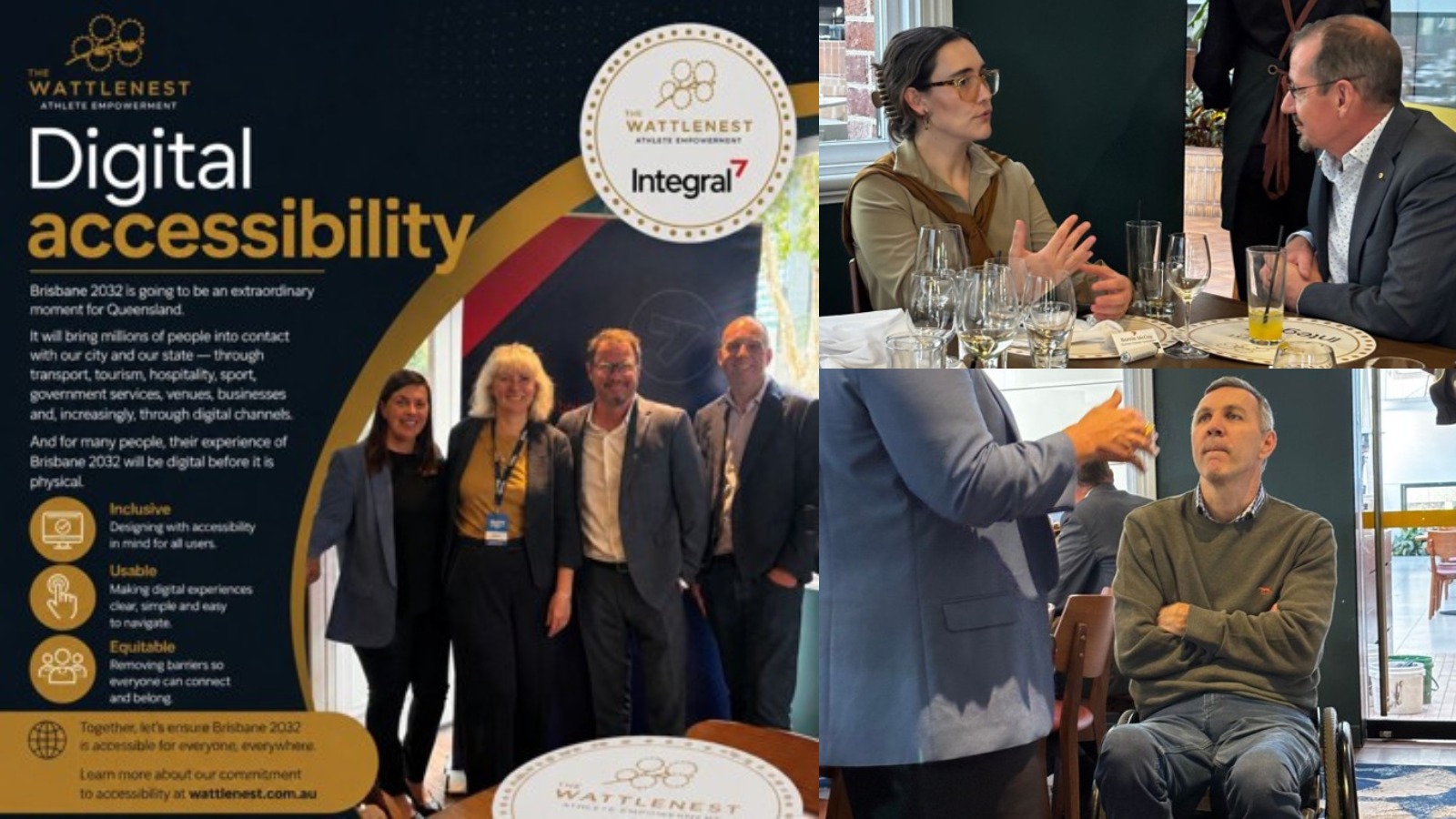
iRAP Chief of Impact Rob McInerney AO joined a diverse group of leaders for a Roundtable on Digital Accessibility last week, exploring the opportunity of the Brisbane 2032 Olympic and Paralympic Games to create more inclusive, connected and sustainable journeys across the State.
Co-hosted by The WattleNest and Integral, with the support of Something Digital, the roundtable brought together government, business, technology, sport and community executives to discuss the opportunities and challenges of digital accessibility. Major events like the Olympics provide a once-in-a-generation opportunity to transform a city and how people move, optimising investment to create a legacy that lasts long after the gates close.
For millions of people, their experience of Brisbane 2032 will be digital before it is physical. They will search for information, book tickets, plan journeys, find accommodation and venues, access government and community services, navigate events, communicate, participate and share their experiences.
The Games presents a unique opportunity to connect these experiences. Digital information, transport systems, roads, paths, crossings, public spaces and venues working together to create vibrant, safe, and inclusive precincts and transport connections that give people confidence, choice and independence to participate.
“The reality is all our journeys are multimodal,” Rob McInerney said. “From walking out the door, to driving to the station, to catching an e-scooter to a venue, and ubering home after the event. If we get it right, and design accessibility into systems from the beginning, there should be no need for ‘hacks’ just to get somewhere. No situation where a person in a wheelchair has travelled beautifully by ferry but then finds themselves confronted with a flight of stairs.
“For iRAP, creating an inclusive Games experience means ensuring the digital and physical journeys work seamlessly together with personalised, needs-specific navigation and a safe, connected mobility ecosystem that puts people first regardless of whether they are walking, wheeling, cycling, riding public transport, or catching autonomous vehicles,” Rob said.
The roundtable reinforced that meaningful accessibility is not the responsibility of one sector or organisation. It requires collaboration across government, business, technology, infrastructure, sport and community – and, critically, the voices and expertise of people with lived experience.
Brisbane 2032 offers Queensland a rare opportunity to use a major global event as a catalyst for something much bigger: digital and physical environments that are safer, more accessible, more inclusive and easier for everyone to navigate.
The ultimate measure of success will not simply be how accessible the Games are in 2032, but what has changed by 2050 because Queensland got it right.
“We’re excited to be working with Brisbane 2032 partners,” Rob said. “It’s one of many major event initiatives iRAP is involved in, working with partners around the world to create 5-star safe, inclusive, accessible and sustainable journeys to Olympic events, the FIFA World Cup, and the F1 Grand Prix in Mexico, Brazil, Italy, Senegal, Spain, Portugal, and more. We’re also proud to be partnering with the UEFA Foundation for Children, Adidas Foundation and the FIA Foundation to expand the “Legacy for the Future” initiative – a milestone partnership to ensure women and girls can navigate their communities safely to reach the football pitches, schools and community spaces they love.”
Read more about iRAP partnerships working to deliver 5-star journeys to events here.